
Northern Circuit Route Kilimanjaro: Complete 9-Day Climbing Guide, Itinerary & Summit Experience
Introduction: Discover the Northern Circuit Route on Mount Kilimanjaro
The Northern Circuit Route is one of the longest, most scenic and highly regarded ways to climb Mount Kilimanjaro, Africa’s highest mountain, standing at 5,895 metres above sea level. Located in northern Tanzania, Kilimanjaro attracts adventure travellers from around the world who dream of reaching Uhuru Peak and experiencing the extraordinary landscapes of the Roof of Africa.
The Northern Circuit is particularly famous for its extended approach, excellent acclimatization opportunities and spectacular views of Kilimanjaro’s northern slopes. Unlike shorter routes that cross the mountain more quickly, this trail takes climbers around much of the northern side before approaching the summit.
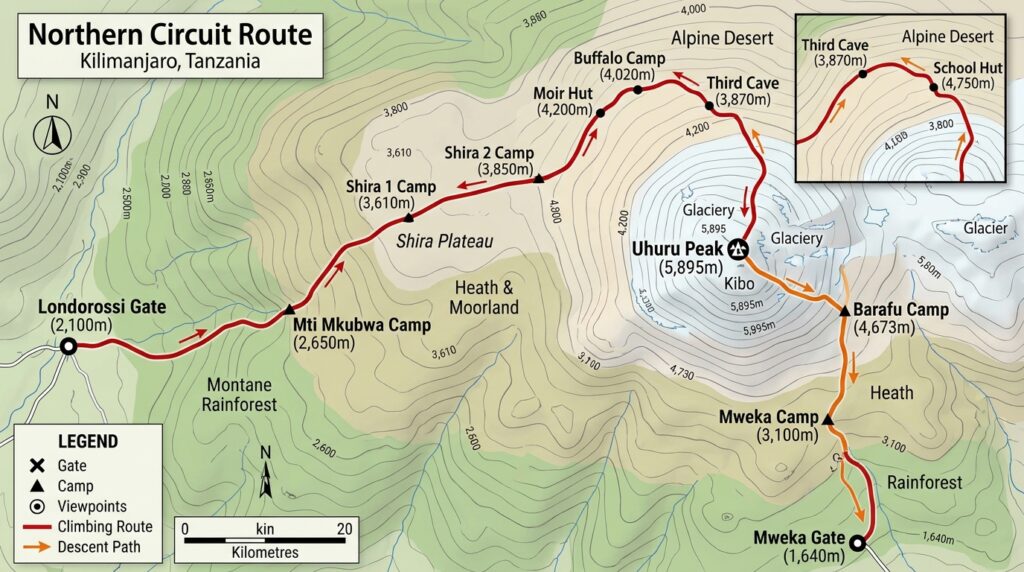
The route begins on the western side of the mountain, following the Lemosho approach before joining the northern circuit around the Shira Plateau. It then continues through remote wilderness areas, including Moir Hut, Buffalo Camp and Third Cave, before approaching the summit from the eastern side.
The Northern Circuit is generally completed in nine days, making it one of the longest standard Kilimanjaro climbing itineraries. Its extended duration gives climbers more time to adjust to altitude and enjoy the different landscapes of the mountain.
At Graceland Adventurous, we help travellers organize unforgettable African adventures, including guided Kilimanjaro climbs, wildlife safaris and East African trekking holidays.
Whether you are travelling alone, as a couple, with friends or in a private group, we can help you plan your Northern Circuit Route Kilimanjaro climbing adventure.
Where Does the Northern Circuit Route Start?
The Northern Circuit Route approaches Mount Kilimanjaro from the western side, beginning at Londorossi Gate.
After completing park registration, climbers are transferred towards the Lemosho trailhead, where the trek begins through the beautiful montane rainforest.
The route initially follows the Lemosho approach, passing through Mti Mkubwa Camp and the Shira Plateau before continuing towards the northern slopes.
From the Shira region, the trail turns north and crosses remote mountain landscapes towards Moir Hut, Buffalo Camp and Third Cave.
The route eventually connects with the eastern approach to Kibo before reaching School Hut, the final overnight camp before the summit attempt.
After reaching Uhuru Peak, climbers descend through the southern side of Kilimanjaro using the Mweka Route.
This extended circuit allows trekkers to experience the western, northern, eastern and southern landscapes of the mountain during one climbing adventure.
Why Choose the Northern Circuit Route for Climbing Kilimanjaro?
The Northern Circuit is an excellent choice for travellers who have enough time for a longer mountain adventure and want to experience more of Kilimanjaro’s remote landscapes.
One of its greatest advantages is its extended itinerary. Spending more days on the mountain provides additional opportunities for gradual altitude adaptation compared with shorter climbing schedules.
The route is also known for its quieter northern sections. While the southern and western approaches can become busy during popular climbing seasons, parts of the Northern Circuit offer a more peaceful wilderness experience.
Another highlight is the variety of scenery. Climbers experience rainforest, heathland, the Shira Plateau, alpine desert and remote northern slopes with expansive views towards the surrounding landscape.
The route also offers impressive views of Mawenzi Peak and Kibo, giving trekkers a different perspective of Kilimanjaro compared with routes that follow the southern circuit.
For travellers seeking a longer, scenic and less hurried approach to the summit, the Northern Circuit is one of the strongest options available.
Northern Circuit Route Kilimanjaro: Complete 9-Day Itinerary
The following is a popular nine-day Northern Circuit itinerary, beginning at Londorossi Gate and descending through Mweka Gate.
Day 1: Londorossi Gate to Mti Mkubwa Camp
Elevation: Approximately 2,100 metres to 2,650 metres
Hiking distance: Approximately 6 kilometres
Hiking time: 3–4 hours
Vegetation zone: Montane rainforest
Your Kilimanjaro adventure begins with a transfer from your hotel in Moshi or Arusha to Londorossi Gate.
After completing park registration and meeting your mountain crew, you continue by vehicle towards the Lemosho trailhead.
The first trekking day takes you through a beautiful montane rainforest characterized by tall trees, thick vegetation and a variety of bird species.
The forest provides a peaceful introduction to the mountain, with opportunities to enjoy the natural environment and observe wildlife along the trail.
After several hours of gradual hiking, you arrive at Mti Mkubwa Camp, also known as Big Tree Camp.
Your mountain crew prepares the campsite and dinner while you relax and prepare for the next stage.
Overnight at Mti Mkubwa Camp.
Day 2: Mti Mkubwa Camp to Shira 1 Camp
Elevation: Approximately 2,650 metres to 3,610 metres
Hiking distance: Approximately 8 kilometres
Hiking time: 5–6 hours
Vegetation zone: Rainforest, heathland and moorland
After breakfast, you leave the rainforest and continue climbing towards the Shira Plateau.
The trail gradually becomes steeper as you move through heathland and open moorland vegetation.
As you gain elevation, the dense forest gives way to shorter plants, giant heathers and rocky mountain terrain.
The scenery becomes increasingly impressive, with views towards the western slopes of Kilimanjaro.
Eventually, you reach Shira 1 Camp, situated on the western side of the Shira Plateau.
This is an excellent place to rest, enjoy the mountain scenery and prepare for the next trekking day.
Overnight at Shira 1 Camp.
Day 3: Shira 1 Camp to Shira 2 Camp
Elevation: Approximately 3,610 metres to 3,850 metres
Hiking distance: Approximately 7 kilometres
Hiking time: 3–4 hours
Vegetation zone: Moorland and alpine heath
The third day involves a gradual ascent across the spectacular Shira Plateau.
The walking trail passes through open mountain landscapes with impressive views of Kibo Peak.
The Shira Plateau is a high-altitude volcanic landscape formed by ancient volcanic activity. Its wide open terrain provides a striking contrast to the rainforest encountered during the first days.
The relatively gentle walking conditions provide an opportunity to enjoy the scenery while allowing your body additional time to adjust to the increasing altitude.
Upon reaching Shira 2 Camp, you can rest, enjoy your meals and prepare for the next stage.
Overnight at Shira 2 Camp.
Day 4: Shira 2 Camp to Moir Hut
Elevation: Approximately 3,850 metres to 4,200 metres
Hiking distance: Approximately 7 kilometres
Hiking time: 4–6 hours
Vegetation zone: Alpine heath and alpine desert
After breakfast, you leave Shira 2 Camp and continue towards Moir Hut on the northern side of Kilimanjaro.
The trail gradually moves away from the main western approach, taking you into quieter and more remote mountain terrain.
The landscape becomes increasingly rocky, with sparse vegetation and wide views of the surrounding volcanic slopes.
Moir Hut is located in a sheltered area beneath the northern side of the mountain.
Depending on the itinerary, weather and your guide’s assessment, an optional acclimatization walk may be arranged in the surrounding higher terrain.
This is an important opportunity to gain additional elevation before returning to camp for overnight rest.
Overnight at Moir Hut.
Day 5: Moir Hut to Buffalo Camp
Elevation: Approximately 4,200 metres to 4,020 metres
Hiking distance: Approximately 12 kilometres
Hiking time: 5–7 hours
Vegetation zone: Alpine desert
The fifth day takes you deeper into the northern circuit, crossing remote high-altitude terrain towards Buffalo Camp.
The route follows a series of gradual ascents and descents across the northern slopes of Kilimanjaro.
You may encounter rocky ridges, open valleys and impressive views towards the Kenyan plains on clear days.
This section is one of the most distinctive parts of the Northern Circuit because it offers a sense of remoteness rarely experienced on the busier climbing routes.
Although the trail includes some challenging sections, the gradual walking pace allows you to enjoy the surrounding landscape.
Upon reaching Buffalo Camp, you settle into your mountain campsite and enjoy dinner prepared by your mountain cook.
Overnight at Buffalo Camp.
Day 6: Buffalo Camp to Third Cave Camp
Elevation: Approximately 4,020 metres to 3,870 metres
Hiking distance: Approximately 8 kilometres
Hiking time: 4–5 hours
After breakfast, you continue across the northern slopes towards Third Cave Camp.
The route includes gentle ascents and descents through the alpine desert environment.
As you walk, you enjoy impressive views of Mawenzi Peak and the northern mountain landscape.
The trail gradually approaches the eastern side of Kilimanjaro, where the landscape begins to change as you move closer to the main summit approach.
Third Cave Camp is an important overnight stop before continuing towards School Hut.
The relatively moderate trekking distance provides time to rest and prepare for the higher-altitude sections ahead.
Overnight at Third Cave Camp.
Day 7: Third Cave Camp to School Hut
Elevation: Approximately 3,870 metres to 4,750 metres
Hiking distance: Approximately 5 kilometres
Hiking time: 4–5 hours
After breakfast, you leave Third Cave Camp and continue towards School Hut, the final overnight stop before the summit attempt.
The trail climbs steadily across rocky alpine desert terrain towards the eastern side of Kibo.
As you gain elevation, the vegetation becomes increasingly sparse and the landscape more exposed.
Upon arrival at School Hut, you have time to rest, enjoy an early dinner and prepare your clothing and equipment for the summit attempt.
Your mountain guide will explain the climbing schedule and provide important safety instructions.
The summit attempt normally begins late at night or around midnight, depending on the operator’s schedule and mountain conditions.
Overnight at School Hut.
Day 8: School Hut to Uhuru Peak and Mweka Camp
Elevation: Approximately 4,750 metres to 5,895 metres, descending to approximately 3,100 metres
Hiking distance: Approximately 16–20 kilometres
Hiking time: Approximately 10–14 hours or longer
This is the most challenging and rewarding day of your Northern Circuit adventure.
You normally begin climbing during the night, accompanied by your mountain guides.
The route follows steep volcanic slopes towards Gilman’s Point on the crater rim, at approximately 5,685 metres.
The high altitude, cold temperatures and steep terrain make this a physically demanding section.
Your guides maintain a slow and steady walking pace to help you manage the conditions.
After reaching Gilman’s Point, you continue along the crater rim towards Stella Point and eventually Uhuru Peak.
At 5,895 metres, Uhuru Peak is the highest point in Africa.
Reaching the summit is an unforgettable achievement. You are standing on the Roof of Africa, surrounded by spectacular views of glaciers, volcanic landscapes and the vast African plains below.
After celebrating your achievement and taking photographs, you begin the descent towards Barafu Camp for a short rest before continuing to Mweka Camp.
Overnight at Mweka Camp.
Day 9: Mweka Camp to Mweka Gate
Elevation: Approximately 3,100 metres to 1,640 metres
Hiking distance: Approximately 10 kilometres
Hiking time: 3–5 hours
Vegetation zone: Montane rainforest
After breakfast, you begin the final descent through the lush montane rainforest towards Mweka Gate.
The lower slopes are generally warmer and more humid, offering a pleasant contrast to the cold conditions experienced during the summit attempt.
The trail passes through beautiful forest vegetation before reaching the park exit.
At Mweka Gate, you complete the park exit formalities and receive your Kilimanjaro climbing certificate if you successfully reached the summit.
Your driver will be waiting to transfer you back to your hotel in Moshi or Arusha.
Your nine-day Northern Circuit Route Kilimanjaro adventure comes to an end.
Northern Circuit Route: 8 Days or 9 Days?
The Northern Circuit can be organized over different durations, depending on the itinerary and the amount of time available.
The eight-day option is shorter and generally involves combining or adjusting some of the trekking stages. It can appeal to climbers with previous high-altitude trekking experience and limited time.
The nine-day itinerary is particularly popular because it allows a more gradual progression around the mountain and provides additional opportunities for acclimatization.
For most first-time Kilimanjaro climbers, we recommend the nine-day Northern Circuit.
The longer itinerary allows you to experience more of the northern slopes while spending additional time adjusting to increasing altitude.
Longer itineraries can improve the opportunity for altitude adaptation, but they do not eliminate altitude sickness risk or guarantee summit success.
How Difficult Is the Northern Circuit Route?
The Northern Circuit is a challenging high-altitude trekking experience.
Although it does not require specialist technical climbing skills, reaching Uhuru Peak involves long hiking days, steep ascents, cold weather and the physical effects of high altitude.
The extended duration means that climbers spend more days walking and sleeping at altitude. This requires good endurance, suitable equipment and a positive attitude.
The summit attempt is particularly demanding because of the elevation, cold temperatures and steep volcanic terrain.
Altitude is one of the biggest challenges. As climbers approach 5,895 metres, reduced oxygen availability makes even ordinary walking more difficult.
Good physical fitness is important, but even experienced and well-trained hikers can experience altitude sickness.
We encourage all climbers to walk slowly, drink sufficient water, eat regularly and communicate any symptoms of altitude sickness to their guides immediately.
Northern Circuit Route Accommodation: Mountain Camping Experience
The Northern Circuit is a camping route, meaning climbers sleep in mountain tents at designated campsites throughout the journey.
Unlike the Marangu Route, which offers permanent mountain huts, the Northern Circuit provides a traditional mountain camping experience.
Your mountain crew normally handles tent setup, campsite preparation and meal arrangements.
A typical climbing package includes sleeping tents, a dining tent, sleeping mattresses, dining equipment and meals prepared by the mountain cook.
The campsites are located in different ecological zones, allowing climbers to experience the changing mountain environment.
The northern camps are particularly attractive to travellers who enjoy remote wilderness surroundings and quieter mountain locations.
At higher elevations, temperatures can become extremely cold, especially during the summit attempt.
A suitable sleeping bag, warm clothing and proper camping equipment are therefore essential.
What Is Included in a Northern Circuit Route Kilimanjaro Package?
A professionally organized Northern Circuit climbing package normally includes:
- Kilimanjaro National Park entrance fees.
- Applicable camping and conservation fees.
- Experienced English-speaking mountain guides.
- Professional mountain porters.
- Mountain cook and prepared meals.
- Drinking water during the climb, subject to the operator’s arrangements.
- Sleeping tents and dining equipment.
- Sleeping mattresses, according to the package.
- Transfers between your hotel and the mountain gates.
- Rescue and emergency support arrangements provided under park regulations.
- Applicable government taxes and levies.
Items that may be excluded include international flights, travel insurance, personal hiking equipment, sleeping bags, hotel accommodation before and after climbing, tips for the mountain crew and personal expenses.
Always request a detailed quotation confirming the exact inclusions and exclusions before booking.
How Much Does the Northern Circuit Route Kilimanjaro Climb Cost?
The cost of climbing Kilimanjaro through the Northern Circuit depends on the number of trekking days, group size, travel season, accommodation arrangements and level of service included.
The nine-day itinerary generally costs more than shorter Kilimanjaro routes because it involves additional park-related expenses, meals, camping fees and mountain crew arrangements.
Private climbs are normally more expensive per person than joining a scheduled group departure.
The Northern Circuit may also involve additional transport and logistical arrangements because of its western starting point and extended northern approach.
When comparing Kilimanjaro climbing packages, travellers should consider the quality of mountain guides, porter welfare, food, camping equipment, safety procedures and the services included in the quotation.
Contact Graceland Adventurous for assistance with planning your Northern Circuit adventure and requesting an updated climbing quotation.
What to Pack for the Northern Circuit Route
Preparing the correct equipment is essential for a comfortable and safe Kilimanjaro climb.
The mountain experiences different climatic conditions, ranging from warm tropical rainforest to freezing summit temperatures.
Important items include:
Clothing: Thermal base layers, fleece jackets, an insulated down jacket, waterproof jacket, waterproof trousers, hiking trousers, warm socks, gloves and a warm hat.
Footwear: Comfortable waterproof hiking boots, camp shoes and gaiters.
Personal equipment: A comfortable daypack, trekking poles, headlamp, sunglasses, sunscreen, water bottles or hydration system and a suitable sleeping bag.
Personal supplies: Toiletries, personal medication, blister treatment, snacks and a small first-aid kit.
Your main duffel bag will generally be carried by porters, while your daypack should contain the equipment and supplies you need during the daily hike.
Your operator should provide a detailed packing list before departure.
How to Prepare Physically for Climbing the Northern Circuit
Physical preparation is important for anyone planning to climb Kilimanjaro through the Northern Circuit.
We recommend starting training several months before your planned climbing date.
Regular hiking is one of the best ways to prepare. Include longer walks, uphill trails and hikes carrying a light backpack.
Cardiovascular activities such as cycling, swimming, jogging and walking can also help improve endurance.
If possible, practise hiking on uneven terrain while wearing the boots you intend to use on Kilimanjaro.
Because the Northern Circuit involves several days of trekking, it is useful to build endurance for consecutive walking days rather than focusing only on short, intense workouts.
It is equally important to understand the effects of altitude. Even physically fit climbers can experience altitude sickness.
Following your guide’s acclimatization instructions, walking slowly and communicating any health concerns are essential parts of the journey.
Is the Northern Circuit Route Suitable for Beginners?
Yes. Beginners can climb Kilimanjaro through the Northern Circuit if they have reasonable physical fitness, proper equipment and sufficient preparation.
The nine-day itinerary is attractive to first-time climbers because it provides a gradual approach and additional time for acclimatization.
However, the longer duration means that climbers must be comfortable spending several days trekking and camping in mountain conditions.
Previous mountaineering experience is not compulsory, and the route does not require specialist technical climbing skills.
We recommend preparing with regular hikes, cardiovascular training and practice walks using your intended hiking equipment.
The support of experienced mountain guides and porters also makes an important difference throughout the journey.
What Is the Best Time to Climb the Northern Circuit Route?
Mount Kilimanjaro can be climbed throughout the year, although some months generally offer better trekking conditions than others.
January to early March: This period generally offers favourable weather conditions, relatively warm temperatures and good opportunities for mountain views.
June to October: These are popular climbing months because they generally experience drier conditions. July, August and September are particularly busy.
November to December: Short rains may occur, especially in November, although climbing is still possible with appropriate preparation.
April and May: These months experience the main rainy season. Trails can become wet and visibility may be affected by cloud cover.
The Northern Circuit spends considerable time on the northern side of Kilimanjaro, which generally receives less rainfall than the southern slopes. However, weather conditions can change quickly, and rain, wind and cold temperatures remain possible.
For travellers looking for a combination of favourable weather and good trekking conditions, January, February, July, August, September and early October are popular choices.
Combining the Northern Circuit Route with a Tanzania Safari
One of the advantages of climbing Kilimanjaro is the opportunity to combine your mountain adventure with a wildlife safari in northern Tanzania.
After completing your climb, you can relax in Moshi or Arusha before exploring some of Tanzania’s most famous national parks.
Tarangire National Park is famous for its large elephant populations, impressive baobab trees and diverse wildlife.
Lake Manyara National Park offers beautiful scenery, birdlife and opportunities to see elephants, giraffes, zebras and other animals.
Ngorongoro Crater is one of Africa’s most remarkable wildlife destinations, with opportunities to see lions, elephants, buffaloes and endangered black rhinos.
Serengeti National Park is famous for its extensive savannah plains, large predator populations and the Great Wildebeest Migration.
Travellers with additional time can also extend their adventure to Zanzibar for a relaxing beach holiday.
Explore our Tanzania wildlife safaris, East Africa safari tours, Uganda wildlife safaris and Rwanda safari adventures to create a complete African travel experience.
Explore More African Adventures with Graceland Adventurous
Graceland Adventurous helps travellers discover some of Africa’s most exciting destinations through mountain trekking, wildlife encounters and unforgettable safari experiences.
Beyond Mount Kilimanjaro, you can explore several other exciting adventures across East Africa.
- Uganda Gorilla Trekking: Experience an unforgettable encounter with mountain gorillas in Bwindi Impenetrable National Park or Mgahinga Gorilla National Park.
- Rwanda Gorilla Trekking: Discover the remarkable mountain gorillas of Volcanoes National Park.
- Akagera National Park Self-Drive Safari: Explore Rwanda’s beautiful savannah landscapes and wildlife with a self-drive safari adventure.
- Uganda Wildlife Safaris: Discover national parks, diverse wildlife and spectacular natural landscapes.
- Rwanda Wildlife Safaris: Experience wildlife viewing in Akagera National Park, including opportunities to see lions, elephants, rhinos and giraffes.
- Tree-Climbing Lions in East Africa: Discover the fascinating tree-climbing lions of Queen Elizabeth National Park in Uganda and Lake Manyara National Park in Tanzania.
Whether you are interested in African mountain climbing adventures, gorilla trekking in East Africa or self-drive African safaris, Graceland Adventurous can help you explore different destinations and experiences.
Northern Circuit vs Lemosho Route: Which Kilimanjaro Route Is Better?
Both the Northern Circuit and Lemosho Route begin on the western side of Kilimanjaro and offer beautiful mountain scenery.
The Lemosho Route crosses the Shira Plateau before joining the southern circuit and approaching the summit from the Barafu side.
The Northern Circuit follows the Lemosho approach initially but continues around the northern slopes, creating a longer journey with more remote mountain scenery.
Lemosho is commonly completed in seven or eight days, while the Northern Circuit is particularly popular as a nine-day climb.
Both routes use mountain camping accommodation and offer opportunities for gradual acclimatization.
Travellers who want a longer climb with an extended circuit around the mountain may prefer the Northern Circuit. Those with less time who still want a scenic western approach may find Lemosho more suitable.
Northern Circuit vs Machame Route: What Is the Difference?
The Northern Circuit and Machame Route both offer spectacular scenery and opportunities to reach Uhuru Peak, but their trekking experiences are different.
The Machame Route approaches from the southern side of Kilimanjaro and is known for its rainforest, Shira Plateau, Lava Tower and Barranco Wall.
The Northern Circuit begins on the western side before continuing around the northern slopes, offering a longer and quieter approach through remote mountain landscapes.
Machame is commonly completed in six or seven days, while the Northern Circuit is generally completed in nine days.
Both routes involve mountain camping, experienced mountain crews and a demanding summit attempt.
Travellers with sufficient time who want a longer itinerary and more time on the mountain may prefer the Northern Circuit. Those looking for a shorter and scenic southern approach may choose Machame.
Why Choose Graceland Adventurous?
Graceland Adventurous is focused on creating memorable African travel experiences through carefully planned adventures, wildlife exploration and mountain trekking.
Our destination experiences cover some of East Africa’s most remarkable attractions, including Mount Kilimanjaro, Uganda’s mountain gorilla habitats, Rwanda’s Volcanoes National Park and Akagera National Park.
We help travellers explore different adventure opportunities, from challenging mountain climbs to wildlife safaris and independent road trips.
Whether you are planning your first Kilimanjaro climb or a wider East African adventure, we can help you discover experiences that match your interests and travel plans.
Frequently Asked Questions About the Northern Circuit Route Kilimanjaro
1. How many days does the Northern Circuit Route take?
The Northern Circuit is most commonly completed in nine days. Shorter itineraries may be available, but the nine-day option provides more time for gradual acclimatization.
2. Where does the Northern Circuit Route start?
The route begins at Londorossi Gate on the western side of Mount Kilimanjaro. Climbers are then transferred to the Lemosho trailhead to begin trekking.
3. Where does the Northern Circuit Route finish?
The descent follows the Mweka Route and finishes at Mweka Gate on the southern side of Kilimanjaro.
4. What is the highest point on the Northern Circuit?
The highest point is Uhuru Peak, at 5,895 metres above sea level.
5. Is the Northern Circuit Route difficult?
Yes. It is a challenging high-altitude trek involving several days of hiking, camping, cold weather and a demanding summit attempt.
6. Is the Northern Circuit suitable for beginners?
Yes. Beginners can climb the route with proper preparation, reasonable physical fitness and sufficient time for acclimatization. The nine-day itinerary is a popular option for first-time climbers.
7. Is the Northern Circuit the longest Kilimanjaro route?
It is generally regarded as the longest of the standard established Kilimanjaro trekking routes, commonly taking nine days.
8. Is the Northern Circuit less crowded?
The northern sections are generally quieter than the popular southern approaches. However, climbers may encounter other groups at shared camps and around the summit.
9. Does the Northern Circuit offer mountain hut accommodation?
No. The Northern Circuit is primarily a camping route, with climbers sleeping in tents at designated mountain campsites.
10. What is the success rate of the Northern Circuit?
Summit success rates vary according to itinerary, weather, operator, climber health and acclimatization. Its longer duration provides more opportunity for altitude adaptation, but no operator can guarantee a successful summit.
11. Do I need previous climbing experience?
No. Previous mountaineering experience is not compulsory. However, good physical preparation, suitable equipment and a suitable climbing itinerary are important.
12. Can I climb the Northern Circuit alone?
You can book as a solo traveller, but Kilimanjaro climbs must be organized with the required registered mountain crew and park-authorized arrangements. Solo travellers can join scheduled group departures or arrange private climbs.
13. What happens if I experience altitude sickness?
Inform your mountain guide immediately. Depending on the severity of your symptoms, the appropriate response may include stopping the ascent, descending and arranging medical assistance or evacuation.
14. Can I combine the Northern Circuit with a Tanzania safari?
Yes. Many travellers combine their Kilimanjaro climb with a wildlife safari to Tarangire, Ngorongoro Crater and Serengeti National Park.
15. Do I need travel insurance for the Northern Circuit?
Yes. Climbers should have travel insurance that specifically covers high-altitude trekking up to at least 6,000 metres and emergency mountain evacuation.
16. What is the best month to climb the Northern Circuit?
January, February, July, August, September and early October are popular months because they generally offer favourable trekking conditions.
17. Why choose the Northern Circuit instead of Lemosho?
The Northern Circuit extends the Lemosho approach by taking climbers around the northern slopes of Kilimanjaro. It offers a longer itinerary, more remote scenery and additional time on the mountain.
Book Your Northern Circuit Route Kilimanjaro Climbing Adventure
Reaching Uhuru Peak is more than an ordinary hiking achievement. It is an unforgettable journey through different climatic zones, spectacular mountain landscapes and one of Africa’s most extraordinary natural environments.
The Northern Circuit offers a distinctive way to experience Mount Kilimanjaro, combining the beautiful Shira Plateau, remote northern wilderness, views of Mawenzi and an extended approach towards the summit.
Whether you are planning your first Kilimanjaro climb or returning for another mountain adventure, Graceland Adventurous can help you organize your trekking experience.
Contact Graceland Adventurous today to start planning your Northern Circuit Route Kilimanjaro climbing adventure!
Destination: Mount Kilimanjaro, Tanzania
Available options: Private climbs and group departures
Recommended duration: 9 days
Accommodation: Mountain camping
Plan your Kilimanjaro adventure and take the first step towards reaching the Roof of Africa!