
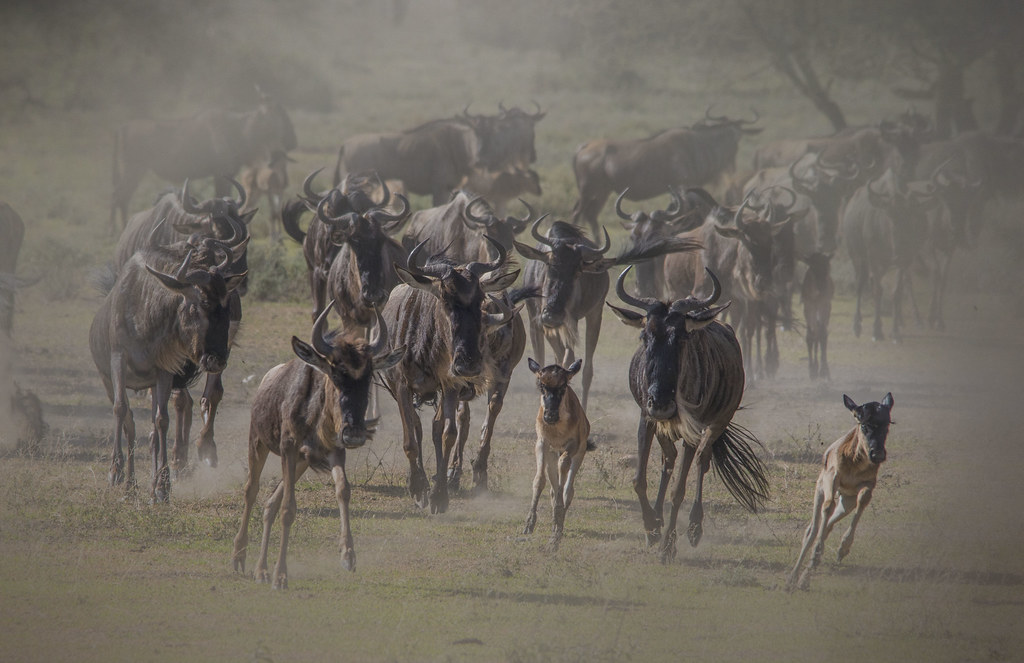
The Contribution of Ngorongoro to the Great Wildebeest Migration
The Ngorongoro Conservation Area plays an important role in the wider Great Wildebeest Migration of East Africa. Although the main migration route is centred on the Serengeti ecosystem, the southern Serengeti and Ngorongoro landscape provides critical grazing areas, water and seasonal habitat for wildebeest, zebra and other herbivores.
For travellers planning a migration safari in Tanzania, understanding the relationship between Ngorongoro and the Serengeti helps explain why the migration is much more than a simple movement between two famous national parks.
The migration follows rainfall, fresh grass and water. These natural resources connect the southern Serengeti, Ndutu, the Ngorongoro Conservation Area and the wider Serengeti ecosystem into one enormous seasonal wildlife landscape.
Ngorongoro and the Southern Migration
Every year, large herds of wildebeest move southward toward the short-grass plains of the southern Serengeti and the Ndutu area.
The landscape around southern Serengeti and the Ngorongoro Conservation Area provides nutrient-rich grazing that becomes particularly important during the calving season.
This is one of the most important periods of the entire migration.
After travelling through the Serengeti for months, the herds arrive in the southern plains where females give birth to large numbers of calves.
The availability of fresh grass is one of the major reasons the animals concentrate in this region.
Ngorongoro therefore contributes to the migration not simply as a destination, but as part of the larger ecological landscape supporting the herds during one of the most important stages of their annual cycle.
The Importance of Ndutu
When discussing Ngorongoro’s contribution to the migration, Ndutu is particularly important.
Ndutu lies in the southern Serengeti–Ngorongoro border landscape and is closely associated with the annual wildebeest calving season.
During approximately January to March, large numbers of wildebeest gather across the southern plains.
The exact timing varies from year to year, depending on rainfall.
The abundance of young animals also attracts predators.
Lions, cheetahs, hyenas and other predators take advantage of the seasonal concentration of prey, creating some of the most dramatic wildlife viewing of the year.
For visitors, the Ndutu area can therefore provide an opportunity to experience the migration at a completely different stage from the famous river crossings farther north.
Ngorongoro Provides Seasonal Grazing
One of the most important contributions of the Ngorongoro landscape is grazing.
Wildebeest require enormous quantities of grass throughout their annual cycle.
Their movement is largely driven by the availability of nutritious vegetation, which in turn is influenced by seasonal rainfall.
The short-grass plains of the southern Serengeti and adjacent areas provide particularly valuable grazing during the early part of the year.
When rainfall produces fresh vegetation, the herds concentrate in the region.
As conditions change, the animals begin their northward movement.
This is why the migration should not be understood as a fixed route. It is an ecological response to changing environmental conditions.
The Calving Season
The southern Serengeti and Ndutu region is famous for the annual wildebeest calving season.
During the peak calving period, thousands of calves may be born over a relatively short period.
This creates a remarkable transformation in the landscape.
The plains become filled with newborn wildebeest, mothers protecting their young and predators searching for opportunities.
Calving is also essential to the continuation of the migration itself.
The birth of a new generation allows the wildebeest population to continue its annual cycle.
For safari travellers, this makes the Ngorongoro–Ndutu region especially significant because it represents the beginning of one of the migration’s most dramatic chapters.
Ngorongoro and Predator Activity
The concentration of wildebeest during calving season creates excellent conditions for predators.
Predators do not migrate with the wildebeest in the same way. Many resident predators remain in the ecosystem throughout the year and take advantage of seasonal concentrations of prey.
During the calving season, visitors may encounter:
- Lions
- Cheetahs
- Spotted hyenas
- Leopards
- Jackals
- Birds of prey
The relationship between predators and migrating herbivores is one of the most important ecological interactions in the Serengeti–Ngorongoro ecosystem.
For photographers and wildlife enthusiasts, this period can offer opportunities to observe hunting, territorial behaviour, mother-and-young interactions and predator activity around the herds.
The Ngorongoro Crater and the Migration
It is important to distinguish between Ngorongoro Crater and the wider Ngorongoro Conservation Area.
The famous crater is an enclosed volcanic caldera with a large resident wildlife population. It is not the main route of the annual wildebeest migration.
The wider Ngorongoro Conservation Area, however, contains extensive landscapes outside the crater that connect ecologically with the southern Serengeti and provide important grazing areas for migratory herbivores.
Therefore, a traveller visiting the Ngorongoro Crater should not expect to see the main migration moving through the crater floor.
Instead, the broader conservation area and especially the southern plains around Ndutu are much more closely associated with the seasonal movement.
Ngorongoro as a Link Between Ecosystems
The importance of Ngorongoro becomes clearer when the migration is viewed as a complete annual cycle.
The animals move through a vast landscape rather than remaining inside one protected area.
A simplified pattern looks like this:
Southern Serengeti and Ndutu → Central Serengeti → Western Corridor → Northern Serengeti → Maasai Mara → Northern Serengeti → Central Serengeti → Southern Serengeti and Ndutu
The Ngorongoro landscape forms part of the southern end of this ecological system.
During the early months of the year, the herds concentrate around the southern plains before beginning their northward journey.
This means Ngorongoro is connected to the migration through habitat, grazing, water, breeding and seasonal wildlife movement.
Why Rainfall Matters
Rainfall is one of the most important forces behind the migration.
The wildebeest do not follow a calendar simply because it is January, June or August.
Instead, they respond to environmental conditions.
When rains produce fresh grass in the southern plains, the herds are attracted to the area.
When the vegetation becomes less suitable and new rainfall occurs farther north or west, the animals begin moving.
This explains why migration timing can change from one year to another.
It also explains why the Ngorongoro landscape is particularly important during the southern wet-season period.
Wildebeest Are Not the Only Animals Involved
Although wildebeest receive most of the attention, the migration involves a much broader community of herbivores.
Large numbers of zebra move with the wildebeest, while gazelles and other grazing animals occupy different parts of the ecosystem.
These animals interact with the same seasonal changes in grass and water.
The movement of herbivores also supports predators and scavengers.
In this way, the migration is not simply a wildebeest phenomenon. It is a major ecological process affecting many species across the Serengeti–Ngorongoro landscape.
Ngorongoro and the Birth of New Calves
One of the most remarkable aspects of the migration is its connection between movement and reproduction.
The herds travel to the southern plains when conditions are suitable for calving.
This means that the migration is not simply about finding food.
The animals are also moving toward landscapes where females can give birth and where newborn calves can access nutritious grass.
The timing of rainfall therefore influences both grazing and reproduction.
This relationship helps explain why the southern Serengeti and Ndutu area are so important to the annual cycle.
From Ngorongoro to the Western Corridor
After the calving season, the herds gradually begin their northward journey.
They move through the Serengeti, with some groups passing through central areas before continuing toward the Western Corridor.
Eventually, many herds reach the Grumeti region.
This is where the migration encounters another major ecological challenge: the Grumeti River.
The journey therefore develops through a series of different landscapes.
The southern plains support calving.
Central Serengeti provides grazing and movement corridors.
The Western Corridor provides another major feeding area and the Grumeti River.
Northern Serengeti provides access toward the Mara River and Maasai Mara.
Ngorongoro’s contribution is therefore most significant at the southern end of this continuous ecological story.
Ngorongoro and the Great Migration Safari
For travellers planning a Tanzania migration safari, combining Ngorongoro and Serengeti makes ecological and practical sense.
A northern Tanzania itinerary can introduce visitors to the volcanic landscapes of Ngorongoro before continuing toward the southern Serengeti and Ndutu or onward to central Serengeti.
A migration-focused itinerary might include:
Arusha → Ngorongoro → Ndutu → Central Serengeti → Western Corridor → Northern Serengeti
This route allows travellers to experience different stages of the migration depending on the season.
During the calving period, the southern areas become the primary focus.
Later in the year, the itinerary can shift toward central, western and northern Serengeti.
Self-Drive and Ngorongoro
Ngorongoro can also be incorporated into a Tanzania self-drive safari, although travellers need to understand that different areas have different access requirements and regulations.
A properly equipped 4×4 is important for a safari combining Ngorongoro and Serengeti.
Travellers should also plan carefully for park and conservation-area rules, permitted routes, accommodation or camping arrangements and seasonal road conditions.
For a migration safari, flexibility is particularly valuable because the location of the herds can change.
A self-drive traveller should therefore avoid planning an itinerary around the assumption that the animals will be in one exact location on a particular date.
Ngorongoro Is More Than a Stop Between Arusha and Serengeti
Many visitors think of Ngorongoro simply as a stopover between Arusha and Serengeti.
Ecologically, however, its importance is much greater.
The conservation area protects a large and varied landscape that forms part of a much wider wildlife system.
Its relationship with the southern Serengeti helps maintain access to important seasonal grazing areas and supports the ecological processes associated with the migration.
For this reason, Ngorongoro adds much more than another wildlife attraction to a Tanzania safari.
The Role of Conservation
The long-term survival of the migration depends on maintaining the landscapes through which the animals move.
The Serengeti–Ngorongoro ecosystem crosses different management areas and land-use zones.
Protecting seasonal grazing areas, water sources and wildlife movement corridors is therefore essential.
The migration demonstrates why wildlife conservation cannot always be limited to a single park boundary.
Animals need access to different habitats at different times of the year.
The continued protection of the southern Serengeti, Ngorongoro landscape and wider migration corridors is therefore important to the long-term ecological health of the system.
Best Time to Experience Ngorongoro and the Migration
The best period depends on which part of the migration you want to experience.
| Period | Migration experience around the Ngorongoro landscape |
|---|---|
| January | Herds concentrate in the southern Serengeti/Ndutu region |
| February | Peak calving activity in many years |
| March | Calving continues and herds begin preparing for movement |
| April | Herds begin moving northward as conditions change |
| May | Migration continues toward central and western Serengeti |
| June–July | Western Corridor and Grumeti become increasingly important |
| August–October | Northern Serengeti and Maasai Mara become key migration areas |
| November–December | Herds move south toward the southern plains |
These are broad seasonal patterns. Rainfall and local ecological conditions can cause significant variation.
Why Ngorongoro Matters to the Migration
The contribution of Ngorongoro to the Great Wildebeest Migration can be summarized through several important functions:
Seasonal grazing: The southern plains provide valuable grass during the wet season.
Calving habitat: The Ndutu and southern Serengeti landscape supports one of the migration’s most important breeding periods.
Predator ecosystem: Concentrations of migrating herbivores provide seasonal food for predators.
Wildlife connectivity: The wider landscape forms part of the ecological relationship between southern Serengeti and the rest of the migration route.
Conservation: Protecting the landscape helps maintain the wider ecosystem on which migratory wildlife depends.
Experience Ngorongoro as Part of the Migration Story
The Great Wildebeest Migration is often presented through images of dramatic river crossings.
But the migration begins long before a wildebeest reaches the Mara River.
It begins with rainfall, fresh grass, reproduction and the movement of enormous herds across the southern plains.
The Ngorongoro landscape is closely connected to this early stage.
Here, the migration story is about birth, grazing and survival.
Later, the same herds continue north through the Serengeti toward the Grumeti and eventually the Mara River.
Understanding this connection gives travellers a deeper appreciation of the migration.
Instead of viewing Ngorongoro, Serengeti and Maasai Mara as completely separate safari destinations, they can be understood as parts of a much larger ecological system.
Frequently Asked Questions
Does the wildebeest migration pass through Ngorongoro Crater?
The main migration does not pass through the Ngorongoro Crater. The crater has a large resident wildlife population. The wider Ngorongoro Conservation Area, particularly the southern landscape around Ndutu, is much more closely connected with the seasonal migration.
Why is Ndutu important to the migration?
Ndutu is an important calving area associated with the southern Serengeti–Ngorongoro landscape. During the wet-season calving period, large numbers of wildebeest concentrate there.
When is the migration near Ngorongoro?
The southern Serengeti and Ndutu area are generally most closely associated with the migration from approximately January through March, although timing varies with rainfall.
Can I see wildebeest and the Ngorongoro Crater on the same safari?
Yes. A northern Tanzania safari can combine Ngorongoro with Serengeti and, depending on the season, the migration areas around Ndutu.
Does Ngorongoro contribute to the Mara River crossings?
Its contribution is indirect and ecological rather than being a direct crossing point. The southern Ngorongoro–Serengeti landscape supports the early stages of the annual cycle before many herds move north toward the Grumeti and Mara river systems.
Is Ngorongoro part of the Serengeti ecosystem?
Ngorongoro is a distinct conservation area, but it is ecologically connected with the Serengeti and forms part of the wider landscape used by wildlife.
Conclusion
The contribution of Ngorongoro to the Great Wildebeest Migration is best understood through its role in the southern part of the annual cycle.
The landscape around Ndutu and the southern Serengeti provides important seasonal grazing and calving habitat. The concentration of wildebeest attracts predators and supports a complex web of ecological interactions.
From there, the herds continue their remarkable journey northward through the Serengeti, eventually reaching the Western Corridor, Grumeti region and northern Serengeti before some continue into Kenya’s Maasai Mara.
For travellers, this means that Ngorongoro is not simply an attraction to visit on the way to Serengeti. It is an important part of understanding the ecological story behind one of the world’s greatest wildlife migrations.
A safari that combines Ngorongoro, Ndutu and Serengeti can therefore reveal the migration from its southern calving grounds through the later stages of its annual journey, creating a much deeper and more complete Tanzania wildlife experience.