
The Great Wildebeest Migration in Maasai Mara
The Great Wildebeest Migration in Maasai Mara is one of the most spectacular wildlife experiences in Kenya and one of the most famous natural events in Africa.
Every year, enormous herds of wildebeest move from Tanzania’s Serengeti ecosystem into Kenya’s Maasai Mara, accompanied by large numbers of zebras and gazelles. Their arrival creates extraordinary concentrations of wildlife across the Mara’s open grasslands and provides exceptional opportunities to observe predators, grazing herds and dramatic river crossings.
The migration is not a single event that happens on a specific date. It is a continuous natural cycle driven primarily by rainfall, fresh grazing and water availability.
For travellers planning a Kenya safari, the Maasai Mara provides one of the best-known settings in which to experience the northern part of this remarkable annual journey.
What Is the Great Wildebeest Migration?
The Great Wildebeest Migration is the seasonal movement of approximately 1.5 million wildebeest through the wider Serengeti–Mara ecosystem.
The animals spend different parts of the year in different areas of Tanzania and Kenya.
As seasonal conditions change, the herds move toward areas with fresh grass and water.
Wildebeest are accompanied by:
- Zebras
- Thomson’s gazelles
- Other antelope
- Lions
- Cheetahs
- Leopards
- Spotted hyenas
- Nile crocodiles
The result is a constantly changing wildlife spectacle across one of East Africa’s most important ecosystems.
Why Is Maasai Mara Important to the Migration?
The Maasai Mara forms the northern extension of the larger Serengeti ecosystem.
Its extensive grasslands provide grazing for migrating wildebeest and zebras, while rivers and other water sources support wildlife throughout the year.
When the migrating herds arrive, they mix with the Mara’s resident wildlife.
This creates an extraordinary concentration of herbivores and predators.
The Mara is therefore not simply a destination for seeing wildebeest. It is a complete ecosystem where visitors can experience:
- Large herbivore herds
- Predators
- River wildlife
- Birdlife
- Scenic grasslands
- Maasai culture
- Sunrise and sunset landscapes
When Do the Wildebeest Reach Maasai Mara?
The migration is commonly associated with July to October in the Maasai Mara.
However, the timing changes from year to year.
Rainfall in Tanzania and Kenya influences the availability of grass and water, and this determines when different groups of animals begin moving.
Some herds may enter the Mara earlier, while others may arrive later.
Different groups can also move at different speeds.
For this reason, there is no official date on which “the migration starts” in the Maasai Mara.
July: The Herds Begin Moving North
July can mark the beginning of significant migration activity in the Mara ecosystem.
After spending the earlier part of the year in Tanzania, some herds begin moving toward northern Serengeti and eventually into the Maasai Mara.
During this period, visitors may encounter large groups of wildebeest entering or moving through the Mara.
The exact timing depends on seasonal rainfall.
July can also provide excellent opportunities to see the Mara’s resident wildlife, including lions, elephants, buffaloes, giraffes and cheetahs.
August: Migration Activity in the Maasai Mara
August is often associated with substantial migration activity in the Mara.
Large herds may be spread across different sections of the ecosystem.
This is also a period when river crossings may occur.
However, travellers should understand that seeing wildebeest in the Mara does not automatically mean seeing a river crossing.
The animals may spend considerable time feeding on the plains before reaching the river.
September: Large Herds and Predators
During September, migrating wildebeest may still be present in significant numbers.
The Mara’s predators benefit from the abundance of prey.
Lions, cheetahs, hyenas and leopards may be encountered in areas frequented by the herds.
The open grasslands can provide excellent conditions for wildlife viewing and photography.
October: The Return Journey
By October, some herds may begin moving back toward Tanzania.
The timing is influenced by rainfall and the availability of fresh pasture.
Some wildebeest may remain in the Mara while others begin moving south.
This makes October an interesting period for travellers because wildlife movement can be spread across different areas.
The Mara River Crossing
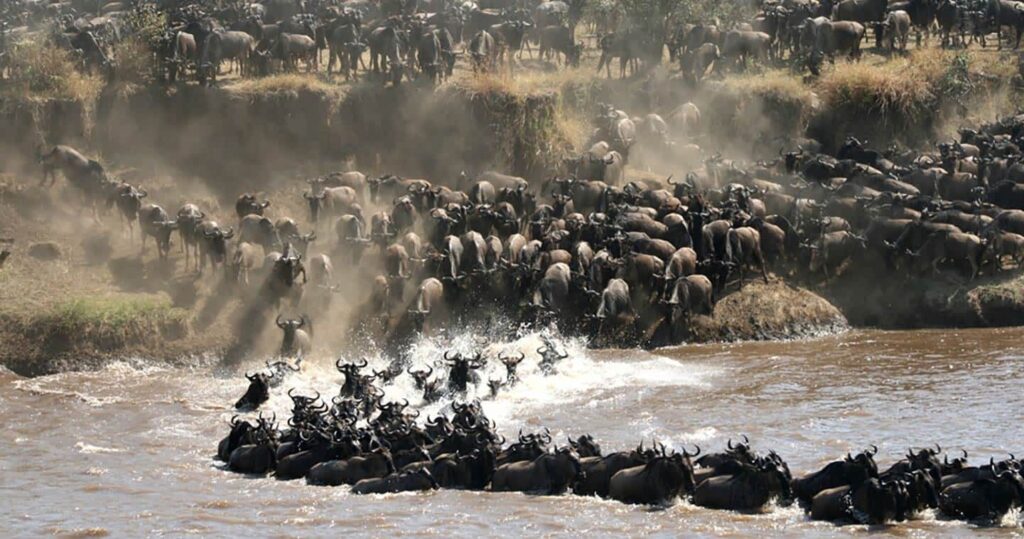
The Mara River crossing is perhaps the most famous scene associated with the Great Wildebeest Migration.
Large herds gather along the river before some animals attempt to cross.
The sight of thousands of wildebeest and zebras moving down riverbanks and into the water can be spectacular.
The crossing is also dangerous for the animals.
They must deal with:
- Deep water
- Strong currents
- Steep riverbanks
- Crowded conditions
- Nile crocodiles
- Exhaustion
But the most important thing for visitors to understand is that river crossings cannot be predicted precisely.
A herd may arrive at the river and wait for hours or days.
It may move along the riverbank without crossing.
It may cross at a different location.
It may even turn around and move back toward the plains.
Therefore, a safari should be planned around experiencing the migration rather than guaranteeing a crossing.
Where to Experience the Migration in Maasai Mara
The Maasai Mara ecosystem includes different areas with varying landscapes and wildlife concentrations.
Travellers may explore:
Maasai Mara National Reserve
The main reserve provides access to extensive wildlife areas and the migration route.
Mara River Area
This is one of the key regions associated with the famous river crossings.
Mara Triangle
The Mara Triangle offers another important section of the ecosystem, with open plains and diverse wildlife.
Surrounding Conservancies
Private conservancies around the reserve can provide additional wildlife experiences and, depending on the conservancy, different safari and vehicle rules.
Travellers should always check the specific regulations of the area they plan to visit.
Wildlife Beyond the Wildebeest
One of the biggest advantages of visiting Maasai Mara during migration season is the variety of wildlife.
Even when the herds are not crossing a river, the Mara can provide excellent game viewing.
Lions
The Maasai Mara supports significant lion populations.
The presence of migrating wildebeest and zebras provides additional prey opportunities for resident prides.
Cheetahs
The Mara’s open plains are excellent habitat for cheetahs.
They use their speed to pursue prey across relatively open ground.
Leopards
Leopards are more elusive and are often associated with areas containing trees and thicker vegetation.
Patient game drives can provide opportunities to encounter these secretive cats.
Spotted Hyenas
Spotted hyenas are both predators and scavengers and play an important role in the Mara ecosystem.
They can often be seen around areas with high concentrations of prey.
Elephants
Elephants are resident animals in the Maasai Mara ecosystem.
They may be encountered throughout the year, regardless of the location of the migrating herds.
Giraffes and Buffaloes
Giraffes and buffaloes are also common residents of the Mara ecosystem.
This means that a safari can remain rewarding even when migration activity is limited.
Wildebeest and Zebras
The wildebeest are not travelling alone.
Large numbers of zebras accompany them through the Serengeti–Mara ecosystem.
The two species have different feeding preferences, allowing them to make use of the grasslands in complementary ways.
Thomson’s gazelles and other antelope also form part of the wider migration landscape.
Maasai Mara Migration Photography
The Maasai Mara is an excellent destination for wildlife photography.
The open grasslands allow photographers to capture large herds against dramatic landscapes.
Migration photography opportunities can include:
- Wildebeest herds
- Zebra herds
- River crossings
- Lions
- Cheetahs
- Leopards
- Crocodiles
- Predators hunting
- Calves
- Sunrise
- Sunset
- Maasai cultural scenes
Photographers should remain patient.
The most memorable moments are often unpredictable, and spending several days in the ecosystem provides more opportunities to observe natural behaviour.
Self-Drive Maasai Mara Migration Safari
For experienced travellers, a 4×4 self-drive Maasai Mara safari can provide an independent way to explore the ecosystem.
Self-driving allows travellers to plan their own schedule and spend more time observing wildlife.
However, the Maasai Mara is a wilderness area, and self-drive visitors need to understand the rules of the reserve or conservancy they are visiting.
A suitable 4×4 vehicle is recommended.
Travellers should plan for:
- Reserve entry requirements
- Conservancy regulations
- Road conditions
- Navigation
- Fuel
- Vehicle recovery
- Camping arrangements
- Weather
- Wildlife safety
- Emergency communication
A 4×4 with a rooftop tent can also be suitable for travellers who want to combine self-drive with camping, provided camping is undertaken in authorized locations.
Maasai Mara Rooftop Tent Safari
For adventurous travellers, a rooftop-tent safari provides another way to experience Kenya.
A properly equipped 4×4 can provide:
- Rooftop tent
- Mattress
- Bedding
- Camping table
- Camping chairs
- Cooking equipment
- Fridge or cooler
- Recovery equipment
- Water storage
The exact equipment varies between rental companies.
Camping locations should always be confirmed in advance, and travellers should follow all applicable reserve, conservancy and campsite rules.
Maasai Mara Migration Safari Routes
The Maasai Mara can be incorporated into several different Kenya safari itineraries.
Short Maasai Mara Safari
Nairobi → Maasai Mara → Nairobi
This is suitable for travellers with limited time who want to concentrate on the Mara.
Kenya Wildlife Circuit
Nairobi → Lake Nakuru → Lake Naivasha → Maasai Mara
This route combines the Mara with other destinations in Kenya’s Great Rift Valley.
Amboseli and Maasai Mara Safari
Nairobi → Amboseli → Nairobi → Maasai Mara
This itinerary combines the Mara’s migration landscape with views of Mount Kilimanjaro and Amboseli’s wildlife.
Kenya–Tanzania Migration Route
Nairobi → Maasai Mara → Serengeti → Ngorongoro → Arusha
This allows travellers to experience both sides of the Serengeti–Mara ecosystem.
Best Time for a Maasai Mara Migration Safari
| Month | General Activity |
|---|---|
| June | Herds moving north toward the Mara |
| July | Migration may begin entering the Mara |
| August | Large herds and possible river crossings |
| September | Continued migration and predator activity |
| October | Herds may begin moving south |
| November | Many herds returning toward Tanzania |
These are general patterns and should not be treated as fixed dates.
Rainfall remains one of the most important factors influencing the movement of the herds.
How Long Should You Stay in Maasai Mara?
For travellers specifically interested in the migration, spending several nights in the Mara provides more opportunities than a short visit.
A three- to five-night stay can provide enough time to explore different areas and respond to changing wildlife activity.
Travellers hoping to see a river crossing should consider allowing additional time because crossings are unpredictable.
The longer you stay, the greater your opportunity to experience different wildlife behaviour.
Responsible Tourism During the Migration
The Great Migration is a natural process, and responsible wildlife viewing is essential.
Visitors should:
- Follow reserve regulations
- Maintain appropriate distances from wildlife
- Avoid blocking animals
- Follow guide and ranger instructions
- Remain inside designated areas
- Avoid disturbing animals at river crossings
- Never feed wildlife
- Respect local communities and cultural practices
During river crossings, large numbers of safari vehicles can sometimes gather around viewing areas.
Responsible driving and following local regulations help protect both visitors and wildlife.
Maasai Culture and the Migration
A visit to Maasai Mara can also provide opportunities to learn about the communities surrounding the ecosystem.
The Maasai people have a long cultural relationship with the landscapes of southern Kenya and northern Tanzania.
Depending on the itinerary, visitors may have opportunities to visit Maasai communities, learn about traditional lifestyles and experience local cultural activities.
Cultural visits should be arranged respectfully through appropriate local operators and community programs.
Frequently Asked Questions
When is the wildebeest migration in Maasai Mara?
The migration is generally associated with July to October, although exact timing varies according to rainfall, grazing conditions and the movement of the herds.
What month is best for the Maasai Mara migration?
Different months provide different experiences. July to October is generally associated with the period when migrating herds are present in the Mara, but the exact location of the animals cannot be guaranteed.
When does the Mara River crossing happen?
There is no fixed date. Crossings depend on the behaviour of the herds and environmental conditions.
Can I guarantee seeing a wildebeest river crossing?
No. Even during the main migration season, a river crossing may not occur during your visit.
Is Maasai Mara good for self-drive?
Self-drive can be an option for experienced travellers, but the rules vary between the national reserve and surrounding conservancies. Visitors should understand the applicable regulations before entering.
Can I camp in Maasai Mara?
Camping is possible at authorized campsites and designated areas. Wild camping should not be undertaken unless specifically permitted by the relevant authority.
Can I rent a 4×4 with a rooftop tent for Maasai Mara?
Yes, rooftop-tent-equipped 4×4 vehicles are available from some East African rental companies. The vehicle should be appropriate for Kenyan safari conditions and properly equipped for independent travel.
Can I combine Maasai Mara with Serengeti?
Yes. Maasai Mara and Serengeti are part of the same wider ecosystem. A Kenya–Tanzania safari can allow travellers to experience different stages of the migration.
Experience the Great Wildebeest Migration in Maasai Mara
The Great Wildebeest Migration in Maasai Mara is much more than the famous Mara River crossings.
It is a seasonal journey involving millions of animals moving across one of East Africa’s great ecosystems in search of fresh grass and water.
From enormous herds crossing the open plains to lions following their prey and crocodiles waiting in the Mara River, every day in the Mara can bring something different.
The key to planning a successful migration safari is flexibility. Rather than relying on a guaranteed river crossing date, travellers should allow enough time to explore the ecosystem and experience the wider wildlife spectacle.
Whether you choose a luxury lodge, tented camp, mobile safari, guided trip or 4×4 self-drive safari with a rooftop tent, Maasai Mara provides an extraordinary opportunity to experience one of the world’s greatest wildlife migrations.
Plan your Maasai Mara migration safari around the seasonal movement of the herds, allow several days for wildlife viewing, and be prepared for nature to set the schedule.