
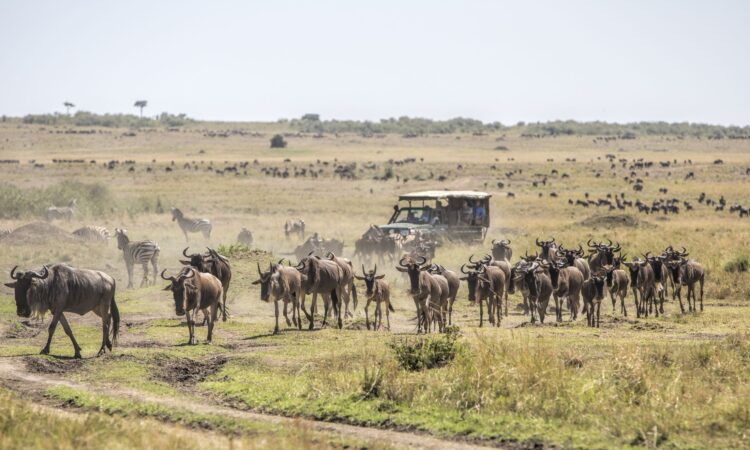
The Great Wildebeest Migration in Tanzania
The Great Wildebeest Migration in Tanzania is one of Africa’s most extraordinary wildlife spectacles. Every year, more than a million wildebeest, together with hundreds of thousands of zebras and gazelles, move across the vast plains of northern Tanzania in search of fresh grass and water.
Although the migration eventually extends into Kenya’s Maasai Mara, much of this incredible natural cycle takes place in Tanzania, particularly within the Serengeti ecosystem. From the calving plains of the south to the northern Serengeti and the Mara River, Tanzania offers opportunities to experience different stages of the migration throughout the year.
For travellers planning a Tanzania safari, understanding the seasonal movement of the herds can help you choose the right destinations and travel period.
What Is the Great Wildebeest Migration?
The Great Wildebeest Migration is a continuous movement of large herds of wildebeest through the Serengeti ecosystem.
The animals follow the availability of fresh grazing and water, responding primarily to seasonal rainfall. Their journey is not controlled by a fixed calendar, meaning that the exact location of the herds can change from one year to another.
Approximately 1.5 million wildebeest participate in the migration, accompanied by large numbers of zebras and gazelles.
The movement also supports an extraordinary predator population. Lions, cheetahs, leopards, hyenas and crocodiles benefit from the enormous concentration of prey, making the migration much more than a spectacle involving wildebeest alone.
The Serengeti: The Heart of Tanzania’s Migration
Serengeti National Park is the centre of Tanzania’s migration experience.
Its enormous grasslands provide grazing areas for the migrating herds, while woodland, river systems and rocky outcrops provide habitats for a wide variety of wildlife.
The Serengeti is divided into different areas, and the migration moves through these regions during different parts of the year.
These include:
- Southern Serengeti
- Ndutu
- Central Serengeti
- Western Serengeti
- Grumeti area
- Northern Serengeti
Choosing where to stay or camp therefore depends greatly on the time of year.
January to March: The Calving Season
The migration begins the year around the southern Serengeti and Ndutu plains.
Following the seasonal rains, the grasslands become rich in nutrients, providing ideal grazing conditions for pregnant wildebeest and their newborn calves.
This is the famous wildebeest calving season.
Thousands of calves can be born during a relatively short period. The abundance of young animals attracts predators, creating excellent opportunities to observe natural predator-prey interactions.
Lions, cheetahs, hyenas and other predators are particularly active during this period.
Why Visit During Calving Season?
The southern Serengeti and Ndutu area can be particularly rewarding for travellers interested in:
- Newborn wildebeest
- Large herds
- Predator activity
- Cheetahs hunting
- Lions following the herds
- Zebra and gazelle
- Photography
- Short-grass plains and dramatic landscapes
Travellers should remember that wildlife movements depend on rainfall, so exact concentrations cannot be guaranteed.
April to May: Moving Through the Serengeti
As the rains continue and the grasslands change, the herds begin moving away from the southern plains.
The migration gradually progresses through central and western parts of the Serengeti.
This is a fascinating period because the landscape can be greener, and wildlife remains widely distributed across the ecosystem.
For travellers, April and May can also offer quieter safari conditions in comparison with some of the peak travel periods.
Road conditions, however, can be more challenging during heavy rains, particularly for self-drive travellers.
June to July: Western and Northern Serengeti
As the dry season develops, the migration gradually moves northwards.
The western Serengeti and Grumeti region become important parts of the journey.
The Grumeti River provides one of the notable natural obstacles along the migration route. Large groups of animals may gather around river systems as they continue north.
By this stage, the herds are increasingly moving toward the northern Serengeti.
This period can be excellent for travellers wanting to combine the migration with a broader Tanzania safari.
A possible itinerary could include:
Arusha → Tarangire → Ngorongoro → Central Serengeti → Western Serengeti → Northern Serengeti
July to October: Northern Serengeti and the Mara River
The northern Serengeti becomes one of the most important areas for migration viewing during the dry season.
Large herds move toward the Mara River and the northern boundary of Tanzania.
This is the period commonly associated with the spectacular Mara River crossings.
Thousands of wildebeest may gather near the river before attempting to cross. The sight of large herds moving down steep riverbanks and through the water can be unforgettable.
However, river crossings are completely natural events.
There is no guaranteed date or location for a crossing. Herds can remain near the river for days, move to another section, or change direction depending on rainfall, water levels and grazing conditions.
For this reason, travellers should plan for the broader migration experience rather than booking a safari solely around the expectation of seeing a river crossing.
Kogatende and Northern Serengeti
The Kogatende area is one of the well-known locations for experiencing the northern migration.
The area provides access to the northern Serengeti landscape and the Mara River region.
During the migration season, travellers may encounter large concentrations of wildebeest and zebras, together with predators that follow the herds.
For visitors who want to experience the migration while remaining entirely within Tanzania, northern Serengeti provides an important option.
November to December: The Journey South
After the northern dry season, the short rains begin changing the landscape.
The herds gradually start moving southwards again.
They pass through central Serengeti and eventually return toward the southern plains.
The cycle then begins again.
This demonstrates an important point about the Great Migration: it is not a single event that happens once a year in one location. It is a continuous ecological cycle.
The Role of Ngorongoro in the Migration
The Ngorongoro Conservation Area, particularly the Ndutu region, is closely associated with the southern part of the migration.
During the calving season, the surrounding plains become an important grazing and breeding area.
Although the Ngorongoro Crater itself is not the main location of the migrating herds, combining Ngorongoro with the southern Serengeti can create a strong Tanzania safari itinerary.
Travellers can experience the crater’s resident wildlife before continuing toward the plains where the migration is taking place.
The Wildlife That Follows the Migration
The wildebeest may be the stars of the migration, but they are part of a much larger ecosystem.
Zebras
Large numbers of zebras travel with the migrating herds.
They feed on different vegetation from wildebeest, allowing the animals to make use of the grasslands in complementary ways.
Gazelles
Thomson’s gazelles and other antelope species can also be found across the Serengeti plains.
Lions
Large concentrations of herbivores provide important opportunities for lions.
The pride structure and hunting behaviour of lions can make encounters particularly interesting during periods when prey is abundant.
Cheetahs
The open plains provide ideal hunting environments for cheetahs.
During the calving season, the abundance of young animals can create opportunities to observe these fast predators hunting.
Hyenas
Spotted hyenas are another important predator in the Serengeti ecosystem.
They are capable hunters and scavengers and can often be encountered around areas with high concentrations of prey.
Crocodiles
The rivers of the Serengeti, including the Grumeti and Mara, are home to large Nile crocodiles.
They are particularly well known for waiting near river crossings when migrating animals enter the water.
Best Time to See the Migration in Tanzania
There is no single best month for everyone because different travellers want different experiences.
| Period | Main Area | What You May Experience |
|---|---|---|
| January–March | Southern Serengeti & Ndutu | Calving, newborns and predators |
| April–May | Central & Western Serengeti | Herd movement and green landscapes |
| June–July | Western/Northern Serengeti | Northward movement and river areas |
| July–October | Northern Serengeti | Mara River region and large herds |
| November–December | Central/Southern Serengeti | Return journey and fresh grazing |
These periods are general guides rather than guaranteed migration schedules.
Rainfall is the major factor determining where the herds will be.
Tanzania Migration Safari Routes
A migration safari can be designed around the expected location of the herds.
Southern Migration Safari
Arusha → Tarangire → Ngorongoro → Ndutu → Serengeti
This route works particularly well around the calving season.
Central Serengeti Safari
Arusha → Ngorongoro → Central Serengeti → Northern Serengeti
This can provide a broader Serengeti experience while following the movement north.
Northern Serengeti Migration Safari
Arusha → Tarangire → Ngorongoro → Central Serengeti → Northern Serengeti
This route is particularly useful during the period when the herds are moving toward the Mara River.
Extended Tanzania Safari
For travellers with more time, the migration can be combined with other Tanzanian destinations.
Arusha → Tarangire → Lake Manyara → Ngorongoro → Serengeti → Northern Serengeti
This allows visitors to experience several different ecosystems rather than focusing exclusively on the migration.
Self-Drive Wildebeest Migration in Tanzania
For experienced travellers, a self-drive safari can provide a different way of exploring the Serengeti.
Driving yourself allows greater flexibility over where to stop, how long to spend watching wildlife and how to structure the journey.
However, the Serengeti is a remote wilderness area, and self-driving requires preparation.
A suitable 4×4 vehicle is recommended, particularly when travelling on rough tracks and during changing weather conditions.
Before entering the parks, travellers should understand:
- Park entry requirements
- Conservation and camping fees
- Vehicle regulations
- Opening and closing times
- Designated camping areas
- Road conditions
- Fuel planning
- Emergency procedures
- Park driving rules
- Cross-border requirements if continuing into Kenya
A 4×4 with a rooftop tent can be an option for travellers who want to combine wildlife viewing with camping.
Why Choose Tanzania for the Wildebeest Migration?
Tanzania provides access to a large portion of the migration’s annual cycle.
The country offers the southern calving grounds, the enormous central Serengeti plains, the western migration routes and the northern Serengeti around the Mara River.
It also allows travellers to combine the migration with some of Tanzania’s other famous attractions.
A single trip can include:
Tarangire National Park
Ngorongoro Conservation Area
Serengeti National Park
Lake Manyara
Arusha National Park
and, for longer itineraries, destinations in southern Tanzania.
Planning Your Migration Safari
The most important consideration when planning a migration safari is the month of travel.
Instead of choosing a destination first and hoping the animals will be there, travellers should begin with their travel dates and then select the areas most likely to offer migration activity during that period.
It is also important to allow some flexibility.
Wild animals do not follow tourism calendars. Rain may arrive early or late, grass conditions can change and herds can move faster or slower than expected.
A good migration safari therefore combines seasonal planning with realistic expectations.
Frequently Asked Questions
When is the wildebeest migration in Tanzania?
The migration takes place throughout the year. Different areas of Tanzania become important during different seasons, with calving generally associated with the southern Serengeti around January to March and the northern Serengeti becoming particularly important later in the dry season.
Where is the migration in Tanzania?
The migration moves through different parts of the Serengeti ecosystem, including the southern, central, western and northern Serengeti. The Ndutu area is particularly important during calving, while northern Serengeti becomes important during the northward movement toward the Mara River.
Can I see the Mara River crossing in Tanzania?
Yes. The Mara River flows through the northern Serengeti, and travellers can potentially witness crossings from the Tanzanian side. However, crossings are unpredictable and cannot be guaranteed.
Is the migration only about wildebeest?
No. Zebras, gazelles and numerous predators are closely associated with the migration. The movement of herbivores also supports lions, cheetahs, leopards, hyenas and crocodiles.
Can I do the migration on a self-drive safari?
Self-drive safaris are possible in parts of Tanzania, but travellers need to understand park regulations, road conditions and the practical challenges of driving in remote wilderness areas. A capable 4×4 and careful preparation are essential.
How long should I spend on a Tanzania migration safari?
A short safari can focus on one migration area, while a longer trip allows you to explore several sections of the Serengeti and combine the migration with destinations such as Tarangire and Ngorongoro.
Experience the Great Wildebeest Migration in Tanzania
The Great Wildebeest Migration is one of the defining experiences of a Tanzania safari.
From the first newborn calves on the southern plains to enormous herds crossing the northern Serengeti, every stage of the journey offers something different.
The most important thing to remember is that the migration is a natural cycle, not a scheduled event. The animals follow rain, grass and water rather than dates on a calendar.
With the right seasonal planning, a suitable safari vehicle and enough time to explore, Tanzania provides an exceptional opportunity to experience this extraordinary movement of wildlife across the Serengeti.
Plan your Tanzania wildebeest migration safari with a route designed around the season, the expected herd movements and the type of safari experience you want.