
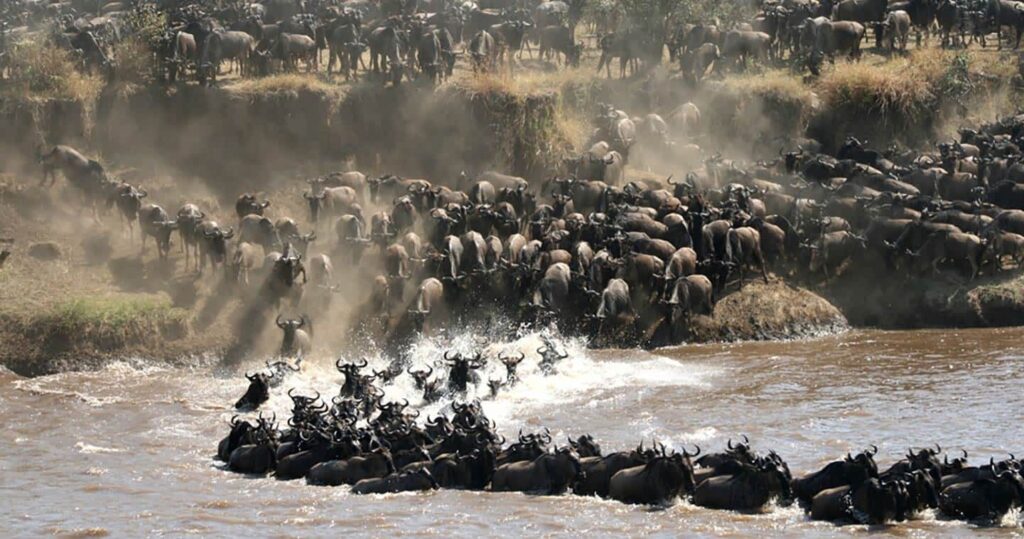
The Great Wildebeest Migration in Kenya
The Great Wildebeest Migration in Kenya is one of the most spectacular wildlife experiences in East Africa. Every year, enormous herds of wildebeest move into Kenya’s Maasai Mara ecosystem, accompanied by large numbers of zebras, gazelles and predators.
The migration connects Kenya’s Maasai Mara with Tanzania’s Serengeti ecosystem. Although the animals spend much of their annual cycle in Tanzania, the period when large herds reach Kenya creates some of the most famous scenes associated with the Great Migration.
For travellers visiting Kenya, the migration offers an opportunity to witness enormous herds crossing open grasslands, interacting with predators and, when conditions allow, attempting to cross the Mara River.
What Is the Great Wildebeest Migration?
The Great Wildebeest Migration is the annual movement of approximately 1.5 million wildebeest, together with large numbers of zebras and gazelles, through the Serengeti–Mara ecosystem.
The animals move in response to seasonal rainfall and the availability of fresh grazing and water.
The migration is therefore not a scheduled event. The herds do not arrive in Kenya on exactly the same date every year.
Weather conditions, rainfall and pasture availability influence when and where the animals move.
The Kenyan section of the journey is centred around the Maasai Mara, particularly during the period when large herds move north from Tanzania.
The Maasai Mara and the Migration
The Maasai Mara National Reserve forms the northern part of the wider Serengeti–Mara ecosystem.
Its open grasslands provide excellent grazing for wildebeest and zebras, while the permanent and seasonal water sources support a rich variety of wildlife.
When the migrating herds enter the Mara, they join resident wildlife populations, creating spectacular concentrations of animals.
The area is also home to major predators, including:
- Lions
- Cheetahs
- Leopards
- Spotted hyenas
- Nile crocodiles
This combination of migrating herbivores and resident predators makes the Maasai Mara one of Kenya’s most famous safari destinations.
When Does the Migration Reach Kenya?
The timing varies from year to year, but the Kenyan migration is generally associated with the July to October period.
During this part of the annual cycle, many wildebeest move north from Tanzania toward the Maasai Mara.
However, there is no guaranteed arrival date.
Some herds may reach the Mara earlier, while others may arrive later. Different groups may also move at different speeds.
This is why experienced safari planners focus on seasonal patterns rather than promising a specific date for the migration.
The Mara River Crossings
The Mara River crossings are among the most famous moments of the Great Wildebeest Migration.
Large herds may gather along the riverbanks before attempting to cross.
The scene can be dramatic as thousands of animals move toward the water, descend steep banks and enter the river.
The river also contains large Nile crocodiles, creating another natural challenge for migrating animals.
However, river crossings are completely unpredictable.
A herd may gather at the river and wait for hours or days before crossing. It may move to another section of the river or even change direction.
For this reason, no responsible safari operator can guarantee that visitors will see a river crossing on a particular day.
Why Are the River Crossings So Dramatic?
Several factors make the crossings spectacular:
- Huge numbers of wildebeest moving together
- Steep riverbanks
- Strong currents
- Deep water
- Nile crocodiles
- Zebras and gazelles moving alongside wildebeest
- Predators waiting near crossing points
The crossing is only one part of the wider migration, but it has become one of the most recognizable wildlife scenes in Africa.
Wildebeest in the Maasai Mara
Once the herds enter Kenya, they spread across the Mara’s grasslands.
The animals spend time feeding on fresh vegetation before eventually beginning their journey south again.
Large herds can sometimes be seen covering the plains, while smaller groups move through different parts of the ecosystem.
The experience can vary considerably from one day to another.
One morning may reveal a large concentration of wildebeest, while another may provide opportunities to observe resident lions, elephants, giraffes, cheetahs and other wildlife.
Predators of the Maasai Mara
The arrival of migrating herbivores creates important feeding opportunities for Kenya’s predators.
Lions
The Maasai Mara is well known for its lions.
The arrival of large numbers of wildebeest and zebras provides additional prey opportunities for resident prides.
Watching lions use the grasslands to approach and hunt prey can be one of the highlights of a Mara safari.
Cheetahs
Cheetahs are particularly suited to the open grasslands of the Maasai Mara.
Their ability to accelerate rapidly makes them effective hunters in open terrain.
The abundance of young or isolated prey animals during the migration can create opportunities for cheetah sightings.
Leopards
Leopards are more secretive than lions and cheetahs.
They are often associated with areas containing trees and dense vegetation, where they can rest during the day and hunt at appropriate times.
Spotted Hyenas
Spotted hyenas are important predators and scavengers within the Mara ecosystem.
They can often be encountered near areas where large concentrations of herbivores are present.
Nile Crocodiles
The Mara River is home to large Nile crocodiles.
During migration crossings, crocodiles may position themselves in or near the river where migrating animals enter the water.
The Migration Is More Than Wildebeest
Although wildebeest are the most famous participants, they are not alone.
Zebras
Large numbers of zebras move alongside wildebeest.
Their feeding patterns complement those of wildebeest, allowing different herbivore species to make use of available vegetation.
Gazelles
Thomson’s gazelles and other antelope can also be found across the Mara ecosystem.
Resident Wildlife
The Maasai Mara contains large populations of wildlife that remain in the area throughout the year.
These include:
- Elephants
- Giraffes
- Buffaloes
- Hippos
- Lions
- Leopards
- Cheetahs
- Hyenas
- Various antelope species
- More than 450 recorded bird species
This means that a safari in the Mara can remain rewarding even when the migrating herds are elsewhere.
Best Time to See the Migration in Kenya
The migration is generally associated with Kenya’s dry-season months.
| Period | General Migration Activity |
|---|---|
| June | Herds moving toward northern Tanzania |
| July | Herds may begin entering the Maasai Mara |
| August | Strong migration activity in the Mara region |
| September | Herds may remain in the Mara depending on conditions |
| October | Gradual movement toward Tanzania |
| November | Many herds begin returning south |
These dates are only general seasonal patterns.
Rainfall determines the actual movement of the animals, so visitors should avoid treating them as fixed migration dates.
Maasai Mara Migration Safari
A Kenya migration safari can be designed around the expected movement of the herds.
A typical itinerary might begin in Nairobi before continuing to the Maasai Mara.
Example Kenya Safari
Nairobi → Maasai Mara → Lake Nakuru → Nairobi
For travellers with additional time, the Mara can be combined with other Kenyan destinations.
Extended Kenya Wildlife Safari
Nairobi → Amboseli → Lake Naivasha → Lake Nakuru → Maasai Mara
This itinerary provides a broader Kenyan safari experience while ending with time in the Mara.
Kenya–Tanzania Migration Safari
Travellers wanting to follow the migration across both countries can combine Kenya and Tanzania.
A possible route is:
Nairobi → Maasai Mara → Serengeti → Ngorongoro → Arusha
Alternatively, travellers can begin in Tanzania and finish in Kenya:
Arusha → Ngorongoro → Serengeti → Maasai Mara → Nairobi
Cross-border travel requires advance planning, including vehicle, immigration, insurance and entry requirements.
Self-Drive Wildebeest Migration in Kenya
For experienced travellers, a 4×4 self-drive safari in Kenya can be an exciting way to explore the Maasai Mara.
Self-driving provides flexibility and allows travellers to spend more time in areas where wildlife activity is taking place.
However, the Mara is a wilderness environment, and visitors should understand the applicable reserve or conservancy rules before travelling.
A suitable 4×4 vehicle is recommended for safari roads and tracks.
Travellers should plan carefully for:
- Park or reserve entry requirements
- Conservancy regulations
- Road conditions
- Navigation
- Fuel
- Camping arrangements
- Wildlife safety
- Weather
- Vehicle recovery equipment
- Emergency communication
For travellers combining self-drive with camping, a 4×4 with a rooftop tent can provide an independent way to explore Kenya.
Camping must always be done in designated or authorized areas.
Where to Stay During the Migration
The location of accommodation is important when planning a migration safari.
Travellers should consider the expected position of the herds rather than simply choosing accommodation based on general proximity to the Maasai Mara.
Options can include:
- Lodges
- Tented camps
- Mobile camps
- Campsites
- Conservancy accommodation
Mobile camps can be particularly useful for travellers following seasonal wildlife movements because they can be positioned in different areas.
Migration and Wildlife Photography
The Maasai Mara provides exceptional opportunities for wildlife photography.
The open grasslands make it possible to photograph large herds against dramatic landscapes.
River crossings can produce spectacular images, but photographers should also look beyond the crossings.
Some of the most interesting photographic opportunities include:
- Wildebeest herds
- Zebras moving together
- Calves
- Lions hunting
- Cheetahs on the plains
- Leopards in woodland
- Crocodiles
- Elephants
- Mara landscapes
- Sunrise and sunset
A longer safari gives photographers more time to observe animal behaviour and respond to changing wildlife activity.
Responsible Wildlife Viewing
The migration is a natural process, and responsible tourism is important.
Visitors should follow local wildlife-viewing regulations and maintain appropriate distances from animals.
During river crossings, vehicles should follow instructions from guides, rangers and reserve authorities.
Visitors should avoid actions that interfere with wildlife behaviour.
The objective is to observe the migration without disrupting the animals’ natural movements.
How Long Should You Spend in the Maasai Mara?
A short visit can provide excellent wildlife viewing, but travellers interested specifically in the migration may benefit from staying several nights.
A three- to five-night Mara safari provides more opportunities to explore different areas and encounter changing wildlife activity.
Longer stays can be especially useful when hoping to witness a river crossing because there is no guarantee that a crossing will happen on the day of your game drive.
Why Visit Kenya for the Wildebeest Migration?
Kenya’s Maasai Mara provides access to one of the most famous stages of the Great Migration.
The combination of open grasslands, large concentrations of wildlife, resident predators and the Mara River creates an extraordinary safari environment.
Unlike a safari focused only on finding migrating animals, a Maasai Mara trip offers a complete wildlife experience.
Even when the wildebeest are not concentrated in one location, visitors can encounter the Mara’s resident wildlife and enjoy the scenery and cultural experiences of the surrounding region.
Frequently Asked Questions
When is the wildebeest migration in Kenya?
The migration is generally associated with July to October in Kenya, although the exact timing changes each year according to rainfall and grazing conditions.
Where can I see the migration in Kenya?
The main destination is the Maasai Mara ecosystem. Different areas of the reserve and surrounding conservancies can experience different levels of migration activity.
When is the Mara River crossing?
There is no fixed date. River crossings depend entirely on the movement and behaviour of the herds and environmental conditions.
Can I guarantee seeing a wildebeest crossing?
No. River crossings are unpredictable natural events. Even during peak migration season, a herd may not cross during a particular safari.
Can I do a self-drive safari in the Maasai Mara?
Self-drive is possible in Kenya, but travellers must follow the rules of the specific reserve or conservancy they are visiting. A capable 4×4 and careful preparation are important.
Can I use a rooftop tent for a Kenya migration safari?
Yes, rooftop-tent camping can be part of a Kenya self-drive safari, provided you use authorized campsites and comply with local regulations.
Can I combine Kenya and Tanzania for the migration?
Yes. The Maasai Mara and Serengeti form part of the same ecosystem, and a properly planned Kenya–Tanzania itinerary can allow travellers to experience different stages of the migration.
Experience the Great Migration in Kenya
The Great Wildebeest Migration in Kenya is much more than a river crossing.
It is the story of millions of animals moving through an interconnected ecosystem in search of fresh grazing and water.
The Maasai Mara provides an extraordinary setting for this natural spectacle, from vast herds moving across the grasslands to predators following the migration and crocodiles waiting in the Mara River.
For travellers planning a Kenya safari, the best approach is to plan around the seasonal movement of the herds, allow enough time for wildlife viewing and remain flexible.
Whether you choose a luxury lodge, a tented camp, a guided safari or a 4×4 self-drive adventure with a rooftop tent, the Maasai Mara offers an unforgettable opportunity to experience one of the world’s greatest wildlife migrations.
Plan your Kenya migration safari around the Maasai Mara, the expected seasonal movement of the herds and the wider wildlife experience—not around a guaranteed river-crossing date.