
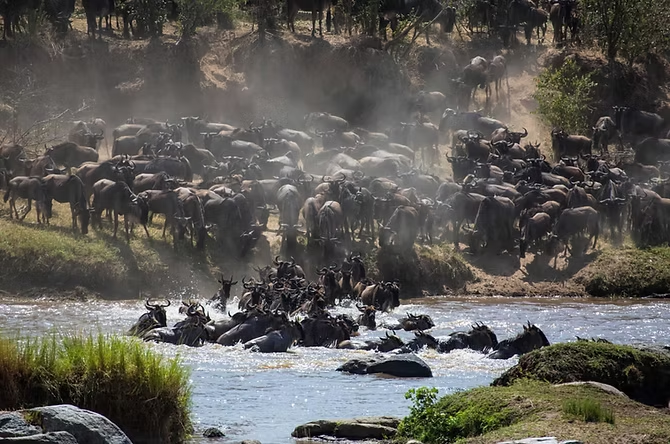
The Great Wildebeest Migration in Serengeti National Park
The Great Wildebeest Migration in Serengeti National Park is one of the world’s most remarkable wildlife spectacles. Each year, more than a million wildebeest, together with hundreds of thousands of zebras and gazelles, move across the vast plains of the Serengeti in search of fresh grass and water.
The migration is not a single event that takes place on a particular day. It is a continuous natural cycle influenced by rainfall, grazing conditions and the availability of water.
For travellers visiting Tanzania, the Serengeti offers opportunities to experience different stages of this extraordinary journey throughout the year, from the calving season in the south to the movement toward the northern Serengeti and the Mara River.
What Is the Wildebeest Migration?
The Great Wildebeest Migration is the seasonal movement of approximately 1.5 million wildebeest through the Serengeti ecosystem.
The animals are constantly searching for fresh grazing. As rainfall changes across the ecosystem, the herds move from one area to another.
Wildebeest are accompanied by large numbers of zebras and gazelles, while predators follow the herds because the concentration of prey provides important feeding opportunities.
The migration therefore creates an ever-changing wildlife spectacle involving:
- Wildebeest
- Zebras
- Thomson’s gazelles
- Lions
- Cheetahs
- Leopards
- Spotted hyenas
- Nile crocodiles
- Numerous bird species
Where Does the Migration Take Place in the Serengeti?
The migration moves through different sections of the Serengeti.
The main areas associated with the migration include:
Southern Serengeti
The southern plains are especially important during the calving season.
Central Serengeti
Central Serengeti provides important grazing areas and remains a major wildlife destination throughout much of the year.
Western Serengeti
The western Serengeti and Grumeti area become important as the herds move north.
Northern Serengeti
Northern Serengeti becomes particularly important later in the year when the herds approach the Mara River.
The movement between these areas means that the best place to see the migration depends on the time of year.
January to March: Calving Season in Southern Serengeti
The beginning of the year brings one of the most fascinating stages of the migration.
After seasonal rains, the southern Serengeti plains and the nearby Ndutu area can become rich with fresh grass.
Large numbers of wildebeest gather to feed and give birth.
Thousands of calves are born within a relatively short period, creating a spectacular concentration of young wildlife.
The calving season also attracts predators.
Lions, cheetahs, hyenas and other carnivores take advantage of the large number of vulnerable young animals.
For wildlife photographers and safari travellers, this can be one of the most dramatic periods to visit the Serengeti.
What Can You See During Calving Season?
Visitors may encounter:
- Large wildebeest herds
- Newborn calves
- Zebras
- Gazelles
- Lions
- Cheetahs
- Hyenas
- Birds of prey
- Other Serengeti wildlife
The exact location and intensity of the calving activity varies according to rainfall and grazing conditions.
April to May: The Herds Move West
Following the calving season, the herds begin moving north and west.
The Serengeti landscape is often green during this period, particularly after seasonal rains.
Large groups of wildebeest can be encountered across different sections of the park.
April and May can also bring wetter conditions, and some roads and tracks may become challenging.
For self-drive visitors, good route planning and a capable 4×4 are particularly important during this period.
June to July: Migration Through Western and Central Serengeti
As the dry season begins, the herds gradually continue northwards.
The western Serengeti becomes an important part of the migration route, particularly around the Grumeti ecosystem.
The Grumeti River is one of the natural obstacles encountered by migrating animals.
Wildebeest and zebras may gather around river areas before continuing their journey.
Central Serengeti can also provide excellent opportunities for wildlife viewing during this period.
July to October: Northern Serengeti and the Mara River
During the dry season, many herds gradually reach the northern Serengeti.
This is the period most commonly associated with the spectacular Mara River crossings.
Large groups of wildebeest may gather along the riverbanks before entering the water.
The crossings can be dramatic. Animals must navigate steep riverbanks, strong currents and deep water, while crocodiles wait in the river.
However, there is no fixed schedule for a crossing.
A herd may gather near the river for several days without crossing. It may also cross at a different location or change direction entirely.
For this reason, a Serengeti migration safari should be planned around experiencing the ecosystem and the herds rather than guaranteeing a particular crossing.
Northern Serengeti Migration
Northern Serengeti is one of the most important regions for travellers wanting to experience the later stages of the migration without leaving Tanzania.
The landscape is different from the central Serengeti, with rocky hills, woodlands and river valleys surrounding the open grasslands.
The Kogatende area is particularly well known for migration viewing.
During the appropriate season, travellers may encounter large herds moving toward or gathering around the Mara River.
Northern Serengeti also offers excellent opportunities to see resident wildlife, meaning the safari can remain rewarding even when the herds are moving elsewhere.
November to December: The Migration Returns South
The arrival of short rains changes the Serengeti landscape once again.
The herds gradually begin moving south.
They travel through the central Serengeti toward the southern plains, where the cycle will eventually begin again.
This return journey demonstrates why the migration should not be viewed as a single annual event.
The animals are continuously moving through the Serengeti ecosystem.
The Serengeti Predators
The Great Migration creates one of Africa’s most impressive predator-prey ecosystems.
Lions
The Serengeti is famous for its lions.
Large concentrations of wildebeest and zebras provide important prey opportunities, particularly when the herds pass through areas occupied by resident lion prides.
Cheetahs
The open Serengeti plains provide excellent habitat for cheetahs.
They rely on speed and open terrain to hunt, and the abundance of young animals during calving season can provide additional opportunities.
Leopards
Leopards are generally more difficult to find because they prefer areas with trees and dense vegetation.
The migration nevertheless contributes to the abundance of prey throughout the ecosystem.
Hyenas
Spotted hyenas are highly adaptable predators and scavengers.
They can be found across the Serengeti and often benefit from the seasonal concentration of herbivores.
Nile Crocodiles
The Grumeti and Mara rivers contain large Nile crocodiles.
During river crossings, crocodiles may wait for migrating animals to enter the water.
Serengeti Migration and Wildlife Photography
The Serengeti provides exceptional opportunities for wildlife photography.
Different seasons offer different subjects.
During calving season, photographers can concentrate on newborn animals and predator interactions.
Later in the year, the northern Serengeti provides opportunities to photograph enormous herds, river landscapes and dramatic wildlife encounters.
A longer stay gives photographers more opportunities to observe animal behaviour rather than simply searching for a single spectacular moment.
Self-Drive Serengeti Migration Safari
The Serengeti can also be explored as part of a carefully planned self-drive safari.
For independent travellers, driving yourself provides flexibility and allows you to spend more time at wildlife sightings.
However, the Serengeti is a large wilderness area, and self-driving requires preparation.
A suitable 4×4 safari vehicle is strongly recommended.
Travellers should consider:
- Park entry requirements
- Vehicle requirements
- Camping regulations
- Road conditions
- Fuel planning
- Navigation
- Emergency communication
- Weather conditions
- Park driving regulations
- Accommodation or campsite availability
A 4×4 equipped with a rooftop tent and camping equipment can be suitable for travellers looking for a more independent safari experience, provided they follow all applicable park regulations.
Serengeti Migration Safari Routes
The route should be selected according to the expected location of the herds.
Calving Season Route
Arusha → Ngorongoro → Southern Serengeti/Ndutu → Central Serengeti
This route is particularly suitable around the calving period.
Central Serengeti Route
Arusha → Tarangire → Ngorongoro → Central Serengeti
This provides a broader northern Tanzania safari while allowing time in the central Serengeti.
Northern Serengeti Migration Route
Arusha → Ngorongoro → Central Serengeti → Northern Serengeti
This route is particularly useful when the herds are moving toward the northern Serengeti and Mara River.
Extended Serengeti Adventure
Arusha → Tarangire → Ngorongoro → Central Serengeti → Western Serengeti → Northern Serengeti
A longer itinerary allows travellers to explore several parts of the Serengeti ecosystem rather than concentrating on one area.
When Is the Best Time to Visit the Serengeti for the Migration?
There is no single month that guarantees the best migration experience.
| Months | Main Migration Area | Typical Experience |
|---|---|---|
| January–March | Southern Serengeti | Calving and predators |
| April–May | Southern/Central/Western Serengeti | Green landscapes and herd movement |
| June–July | Western/Central Serengeti | Northward movement |
| July–October | Northern Serengeti | Large herds and Mara River region |
| November–December | Central/Southern Serengeti | Return journey |
These are broad seasonal patterns. The actual position of the herds depends heavily on rainfall and grazing conditions.
How Long Should You Spend in the Serengeti?
A short Serengeti visit can provide excellent wildlife viewing, but a longer stay increases your opportunity to experience changing wildlife activity.
For travellers specifically following the migration, three to five nights in the Serengeti can provide considerably more flexibility than a very short visit.
Those wanting to follow the migration across several regions may prefer a longer itinerary.
The Serengeti is enormous, and driving between different regions can take significant time.
What Makes the Serengeti Migration Special?
The Great Migration is not simply about seeing millions of animals together.
It is about witnessing a natural cycle that connects:
Rain → Grass → Herbivores → Predators → Rivers → New Life
Every stage of the journey plays a role in the wider Serengeti ecosystem.
The birth of thousands of calves in the south eventually leads to the movement north. The search for water and grazing brings the herds toward the rivers, while the return of rain sends them south again.
The cycle continues year after year.
Frequently Asked Questions
Where is the wildebeest migration in the Serengeti?
The migration moves through different areas of the Serengeti throughout the year. Southern Serengeti is important during calving, while western and central areas become important as the herds move north. Northern Serengeti becomes particularly significant later in the year.
When is the wildebeest migration in Serengeti?
The migration occurs throughout the year. January to March is generally associated with calving in the southern Serengeti, while July to October is commonly associated with the northern migration and Mara River region.
Can I see a river crossing in Serengeti?
Yes, river crossings can occur in northern Serengeti, particularly around the Mara River. However, they are unpredictable and cannot be guaranteed.
Can I visit Serengeti on a self-drive safari?
Yes, self-drive safaris are possible, but visitors must comply with park regulations and be properly prepared for remote wilderness conditions. A suitable 4×4 is recommended.
Is Serengeti good for a rooftop tent safari?
A rooftop tent can be an excellent option for travellers who want to combine a self-drive safari with camping. Camping must be done in permitted areas and according to current park regulations.
Can I see the migration outside July and October?
Yes. The migration is active throughout the year. July to October is particularly associated with the northern Serengeti and Mara River, but the southern calving season and other stages of the journey can provide equally significant wildlife experiences.
Experience the Wildebeest Migration in Serengeti
The Serengeti Wildebeest Migration is a year-round natural spectacle rather than a single event.
From newborn calves on the southern plains to enormous herds moving through the northern Serengeti, each season offers a different perspective of one of the world’s greatest wildlife movements.
Whether you choose a guided safari, a private camping trip or a 4×4 self-drive Serengeti adventure, careful seasonal planning is the key to making the most of your experience.
The Serengeti’s wildlife, landscapes and changing seasons make every journey different—and that is precisely what makes the Great Wildebeest Migration so extraordinary.