
Mara River Wildebeest Crossing: Experience the Great Migration in Kenya
The Mara River wildebeest crossing is one of the most dramatic wildlife spectacles in Africa. Each year, enormous herds of wildebeest move from Tanzania’s Serengeti ecosystem into Kenya’s Maasai Mara, where they encounter the Mara River on their journey in search of fresh grazing and water.
For travellers, witnessing thousands of wildebeest gathering along the riverbank before plunging into the water can be an unforgettable safari experience.
But the Mara River crossing is not a scheduled performance. It is a completely natural event, and nobody can predict exactly when, where or whether a particular herd will cross.
This unpredictability is part of what makes the experience so extraordinary.
What Is the Mara River Wildebeest Crossing?
The Mara River forms an important part of the wider Serengeti–Mara ecosystem, connecting northern Tanzania with southern Kenya.
During the annual migration, large herds of wildebeest and zebras move northward from the Serengeti toward the Maasai Mara.
At various points, the animals encounter the Mara River.
The river presents a major natural obstacle.
The animals must find suitable crossing points, descend sometimes steep riverbanks and enter the water while thousands of other animals are moving around them.
The crossing can be chaotic, noisy and dramatic.
When Does the Mara River Crossing Happen?
The Mara River crossings are generally associated with the July to October migration season.
However, there is no fixed crossing date.
The timing depends on:
- Rainfall
- Availability of grazing
- River conditions
- Herd movement
- Water levels
- Animal behaviour
Some herds may reach the river early, while others arrive later.
A group may also gather at the river and remain there for hours or even days before crossing.
This means that travellers visiting during migration season should understand that seeing wildebeest in the Mara does not guarantee seeing a river crossing.
Why Do the Wildebeest Cross the Mara River?
The wildebeest are following seasonal grazing opportunities.
As conditions change in the Serengeti and Maasai Mara, the herds move toward areas with fresh grass and water.
The Mara River becomes an obstacle along this journey.
The animals do not cross simply because it is a particular month. They cross when their natural movement takes them toward the river and conditions encourage them to continue.
This is why the migration is best understood as a continuous ecological cycle rather than a fixed annual event.
What Happens Before a River Crossing?
One of the most fascinating parts of the experience can occur before the animals actually enter the water.
A large herd may gather along the riverbank.
Thousands of wildebeest may move backward and forward, apparently searching for a suitable crossing point.
Some animals may approach the edge of the river and then retreat.
Others may continue moving along the bank.
The herd can remain in this state for a considerable amount of time.
Suddenly, one animal may enter the water and others begin following.
Within moments, a huge section of the herd can begin moving toward the river.
The Actual Crossing
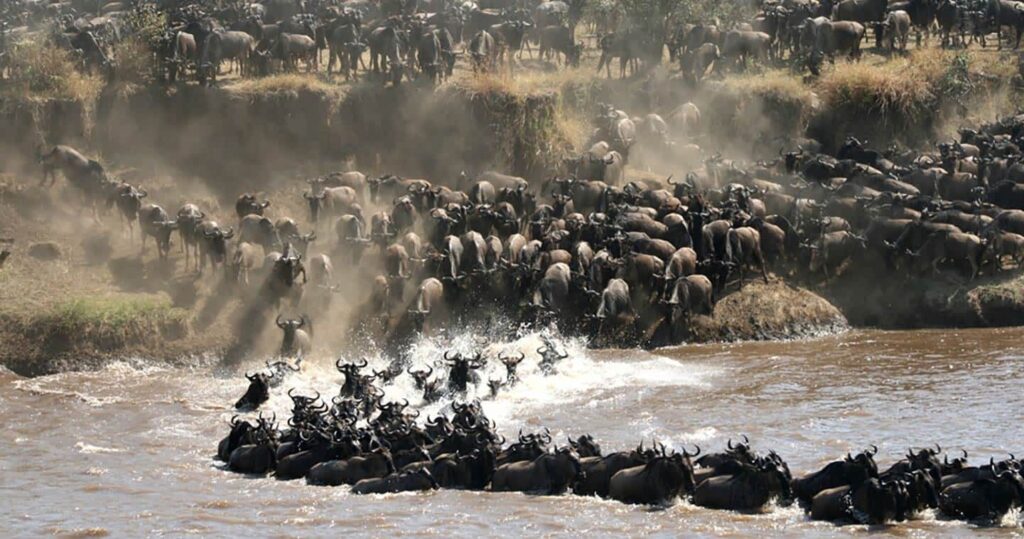
Once the animals commit to crossing, the scene can change rapidly.
Wildebeest move down the riverbank and enter the water.
Zebras may cross alongside them.
The animals swim or wade through the river while trying to reach the opposite bank.
Thousands of animals can become concentrated in a relatively small area.
Dust rises from the riverbanks, animals call to one another and the water becomes filled with moving wildlife.
The crossing may last only a few minutes in one location, while other crossings can continue for much longer as different groups enter the river.
The Dangers of the Mara River
The Mara River is not an easy obstacle.
The animals face several natural dangers during the crossing.
Steep Riverbanks
Some sections of the river have steep banks.
Animals can struggle to descend safely, particularly when large numbers are moving together.
Strong Currents
River conditions vary according to rainfall and water levels.
Strong currents can make crossing difficult for smaller or weaker animals.
Crowding
Thousands of animals moving toward the same crossing point can create confusion.
Wildebeest may slip, fall or become separated from the herd.
Nile Crocodiles
The Mara River is home to large Nile crocodiles.
Crocodiles may wait in the water for opportunities to capture animals entering the river.
Exhaustion
The migration involves long-distance movement, and some animals may already be tired before reaching the river.
The Role of Crocodiles
Nile crocodiles are an important part of the Mara River ecosystem.
They spend much of their time in the water and can remain motionless while waiting for suitable opportunities to hunt.
During migration season, large numbers of wildebeest and zebras provide seasonal feeding opportunities.
However, crocodiles are not the only danger.
The crossing itself is challenging because of steep banks, deep water, currents and the sheer number of animals moving simultaneously.
Where Can You See the Mara River Crossing?
The Mara River extends across the northern Serengeti and Maasai Mara ecosystem.
Travellers can experience river crossings from both the Tanzania and Kenya sides, depending on where the herds are located.
On the Kenyan side, the Maasai Mara provides access to several areas around the river.
On the Tanzanian side, northern Serengeti provides access to the southern part of the Mara River system.
The best viewing location depends on where the herds are at the time of your safari.
Maasai Mara or Northern Serengeti?
Both Kenya and Tanzania can provide opportunities to experience the Mara River migration.
Maasai Mara
The Maasai Mara is the northern section of the ecosystem and is one of the most famous destinations for migration safaris.
Advantages include:
- Extensive grasslands
- Large resident wildlife populations
- Access to Mara River areas
- Excellent predator viewing
- Strong safari infrastructure
Northern Serengeti
Northern Serengeti provides access to the southern side of the Mara River.
It can be an excellent option for travellers who want to remain in Tanzania while experiencing the migration.
The Kogatende area is particularly associated with northern migration activity.
The choice between Kenya and Tanzania depends on travel dates, herd location, itinerary and border arrangements.
Best Time to See the Mara River Crossing
The traditional migration period for Mara River crossings is generally July to October.
| Month | General Migration Activity |
|---|---|
| July | Herds may begin reaching the northern Serengeti and Mara |
| August | River crossing activity may occur |
| September | Large herds may remain in the Mara ecosystem |
| October | Some herds begin moving south |
These dates are only general guidelines.
The actual crossing may happen earlier or later depending on environmental conditions.
How Long Should You Stay?
If your primary goal is to increase your opportunity of witnessing a river crossing, spending only one night in the Mara provides limited flexibility.
A stay of three to five nights or longer gives you more opportunities to monitor herd movements and visit different sections of the ecosystem.
Even then, a crossing cannot be guaranteed.
The longer stay is about increasing opportunities, not securing a particular event.
Planning a Mara River Crossing Safari
A successful migration safari requires more than simply booking accommodation in the Maasai Mara.
Your itinerary should consider:
- Your travel month
- Expected herd location
- Number of nights
- River access
- Accommodation location
- Road conditions
- Reserve regulations
- Wildlife-viewing rules
- Weather
- Transport arrangements
For a self-drive safari, additional preparation is necessary.
A suitable 4×4 safari vehicle is recommended, particularly for travellers exploring remote areas.
Self-Drive Mara River Crossing Safari
For experienced travellers, a Kenya 4×4 self-drive safari can provide an independent way to explore the Maasai Mara.
A self-drive vehicle can allow travellers to respond to changing wildlife activity and explore different parts of the reserve or surrounding conservancies.
However, travellers should understand that wildlife areas have specific regulations.
Before entering the Mara, check:
- Entry fees
- Opening hours
- Vehicle restrictions
- Driving regulations
- Conservancy rules
- Camping regulations
- Road conditions
- Emergency procedures
A 4×4 with a rooftop tent can be an option for travellers who want to combine self-drive with camping.
Camping should only take place at authorized campsites or locations.
Photography at the Mara River
The Mara River crossing provides extraordinary photography opportunities.
However, photographers should be prepared for rapidly changing conditions.
Useful equipment can include:
- Telephoto lens
- Wide-angle lens
- Extra batteries
- Extra memory cards
- Camera protection from dust
- Beanbag or suitable support
- Binoculars
The most important piece of equipment is patience.
The animals may wait for hours before crossing, so spending time observing the herd can be more valuable than constantly moving between locations.
Responsible Viewing of River Crossings
River crossings can attract many safari vehicles.
Responsible behaviour is therefore extremely important.
Visitors should:
- Follow reserve regulations
- Follow guide or ranger instructions
- Avoid blocking animal routes
- Keep appropriate distances
- Avoid driving into restricted areas
- Avoid disturbing the animals
- Remain in authorized areas
The objective is to observe the natural event without interfering with the migration.
The River Crossing Is Only One Part of the Migration
While the Mara River crossing receives enormous attention, it is only one moment in a much larger journey.
A migration safari can also provide opportunities to see:
- Huge wildebeest herds
- Zebra
- Gazelles
- Lions
- Cheetahs
- Leopards
- Hyenas
- Elephants
- Giraffes
- Buffaloes
- Hippos
- Crocodiles
- Birdlife
The wider Maasai Mara ecosystem remains rewarding even when no animals are crossing the river.
Kenya–Tanzania Migration Safari
Travellers with more time can combine the Maasai Mara and Serengeti.
A possible itinerary is:
Nairobi → Maasai Mara → Northern Serengeti → Central Serengeti → Ngorongoro → Arusha
Another option is:
Arusha → Ngorongoro → Serengeti → Northern Serengeti → Maasai Mara → Nairobi
These itineraries allow travellers to experience different parts of the Serengeti–Mara ecosystem.
Cross-border vehicle and immigration requirements should be arranged in advance when travelling between Kenya and Tanzania.
Frequently Asked Questions
When is the Mara River crossing?
River crossings are generally associated with July to October, but there is no fixed date. The timing depends on rainfall, herd movement and river conditions.
Can I guarantee seeing a wildebeest crossing?
No. A river crossing is a natural event and cannot be guaranteed. Even during peak migration season, the animals may not cross while you are there.
How long do wildebeest stay at the Mara River?
There is no fixed duration. Herds can remain near the river for hours or days before crossing, and different groups may behave differently.
Where is the best place to see the Mara River crossing?
The appropriate location depends on where the herds are. Both the Maasai Mara in Kenya and northern Serengeti in Tanzania provide access to sections of the Mara River ecosystem.
What month has the most river crossings?
There is no reliable single month that guarantees the greatest number of crossings. August and September are commonly associated with significant migration activity, but conditions vary from year to year.
Can I see the river crossing on a self-drive safari?
It can be possible, but self-drive travellers must follow all applicable reserve or conservancy regulations and should be prepared for changing road and wildlife conditions.
Is the Mara River crossing dangerous for wildebeest?
Yes. The animals face steep banks, deep water, currents, crowding and predators such as Nile crocodiles. The crossing is a natural part of their migration.
Is the Mara River crossing suitable for children?
Families can visit the Maasai Mara during migration season, but parents should follow the guidance of their safari operator and observe wildlife-safety rules at all times.
Experience the Mara River Wildebeest Crossing
The Mara River wildebeest crossing represents one of the most dramatic moments of the Great Migration.
Watching thousands of wildebeest gather on a riverbank, hesitate before entering the water and eventually make their way across is an experience that can remain with a traveller for years.
But the true beauty of the migration lies in its unpredictability.
There is no timetable, no guaranteed crossing point and no way to control the animals’ decisions.
The best approach is to travel during the appropriate migration season, stay several nights, work with current information about herd movements and remain flexible.
Whether you choose a guided safari, luxury lodge, tented camp or 4×4 self-drive safari with a rooftop tent, the Mara River and surrounding Maasai Mara ecosystem offer an extraordinary opportunity to witness one of nature’s greatest wildlife journeys.
Plan your Mara River safari around the migration, allow sufficient time, and let the animals set the schedule.