
Grumeti Region Wildebeest Migration Experience: Discover the Western Serengeti
The Grumeti Region offers one of the most fascinating chapters of the Great Wildebeest Migration in Tanzania. Located in the western part of Serengeti National Park, the region forms part of the Western Corridor, a beautiful landscape of open grasslands, rolling hills, woodland and riverine forest stretching toward Lake Victoria.
While the northern Serengeti and Maasai Mara are famous for the dramatic Mara River crossings, the Grumeti Region provides a different migration experience. Here, the herds encounter the Grumeti River, one of the first major water obstacles on their northward journey.
The migration usually reaches the Western Corridor around May, June and July, although the exact timing changes from year to year because the wildebeest follow rainfall, fresh grass and water rather than a fixed calendar.
For travellers looking for a quieter and less predictable migration experience, the Grumeti Region can be an exceptional part of a Serengeti safari.
What Makes the Grumeti Region Special?
The Grumeti Region is different from the open plains of southern Serengeti and the busier migration areas farther north.
The landscape becomes greener and more varied as the migration moves west. The Grumeti and Mbalageti Rivers shape the Western Corridor, creating riverine forests, woodland and water sources that support wildlife throughout the year.
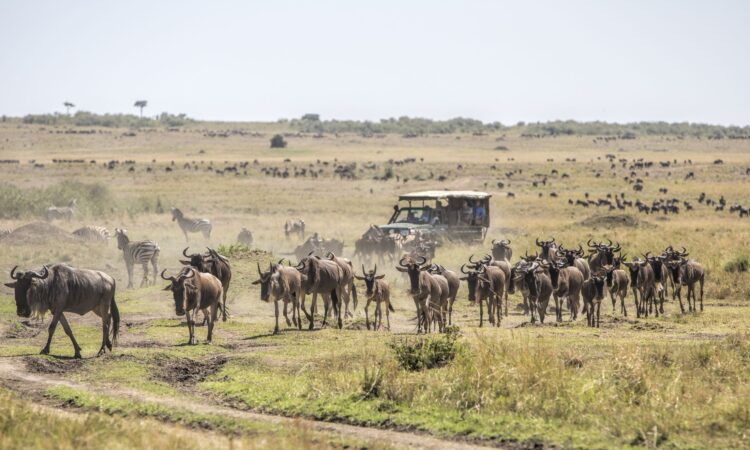
During the migration season, enormous herds of wildebeest move through this landscape, accompanied by large numbers of zebra and other grazing animals.
The animals are not simply travelling from one destination to another. They are responding to changing environmental conditions, particularly the availability of fresh grass and water.
This makes the Grumeti experience about much more than seeing a river crossing. It is an opportunity to observe the migration as a constantly changing natural process.
The Grumeti River: The First Major River Challenge
One of the defining moments of the Western Corridor migration is the arrival of the herds at the Grumeti River.
After moving north and west from the central Serengeti, the wildebeest may gather along the riverbanks. The animals can spend considerable time moving back and forth before committing themselves to the water.
This hesitation is part of what makes the experience so compelling.
Thousands of animals may gather together, creating enormous concentrations of wildebeest and zebra. Then, seemingly without warning, a section of the herd may begin moving toward the river.
The animals enter the water, cross the channels and climb the opposite bank before continuing northward.
The Grumeti River is also home to large Nile crocodiles, creating an important predator-prey interaction during the migration.
However, it is important to understand that a Grumeti River crossing cannot be guaranteed. The herds can change direction, split into smaller groups or move through different sections of the Western Corridor depending on rainfall and local conditions.
When Is the Grumeti Migration?
The general migration window in the Grumeti and Western Corridor is May to July.
June is often associated with strong migration activity in the region, but the timing can shift significantly between years. The animals may arrive earlier or later depending on rainfall and the condition of the grasslands.
A simplified seasonal pattern is:
| Period | General migration activity |
|---|---|
| April | Herds move north and west from the central Serengeti |
| May | Large herds begin entering the Western Corridor |
| June | Strong migration activity around the Grumeti region |
| July | Some herds continue north toward northern Serengeti |
| August onward | Migration increasingly concentrated farther north |
This should be treated as a general guide rather than a fixed timetable. The migration follows ecological conditions, not tourism calendars.
May: The Migration Enters the Western Corridor
May can be an exciting period to explore the Grumeti Region.
Following the calving season in the south, the herds begin their long northward movement. As the grasslands change and rainfall patterns shift, large groups move toward the central and western Serengeti.
The Western Corridor becomes increasingly important as the herds travel toward the Grumeti River.
May can also be an interesting time for visitors because the landscape is often still relatively green following the rains.
For photographers, the combination of large herds, green vegetation, dramatic skies and changing light can produce excellent opportunities.
June: The Grumeti Migration Experience
June is often considered one of the key months for experiencing the migration in the Western Corridor.
Large concentrations of wildebeest may gather around the Grumeti area, while other groups continue moving north.
This is also an excellent period to spend several days in the region rather than simply passing through.
A longer stay gives your safari guide more time to follow the movement of the animals and search for active areas along the river and surrounding plains.
The Grumeti experience is particularly attractive to travellers who prefer a quieter safari atmosphere compared with the highly publicized Mara River crossings farther north.
July: Following the Herds North
By July, parts of the migration may already be moving beyond the Western Corridor toward northern Serengeti.
However, migration timing varies considerably, and some groups may remain in or around the western region.
This is why safari planning should focus on tracking the migration rather than relying solely on a calendar date.
Travellers visiting during July can also combine the Western Corridor with northern Serengeti, creating an itinerary that follows the migration as it moves north.
The Wildebeest and Zebra Herds
The wildebeest are the main stars of the migration, but they are not travelling alone.
Large numbers of zebra move with the herds, while other grazing animals may also be encountered along the route.
The movement of these animals creates one of Africa’s greatest wildlife spectacles.
From a safari vehicle, you may see enormous columns of animals stretching across the plains, dust rising behind them as they move from one grazing area to another.
At other times, the herds can appear scattered across the landscape.
This changing pattern is an important part of the migration experience.
Predators of the Grumeti Region
Where large numbers of herbivores gather, predators are never far away.
The Western Corridor supports resident populations of lions, leopards, hyenas and other predators.
For predators, the migration provides an enormous seasonal food opportunity.
A safari in the Grumeti Region can therefore combine migration viewing with excellent general game viewing.
You may encounter:
- Lions
- Leopards
- Spotted hyenas
- Cheetahs
- Elephants
- Giraffes
- Hippos
- Crocodiles
- Buffalo
- Various antelope species
- Large numbers of resident and migratory herbivores
The riverine environment can be especially productive for wildlife.
The Crocodiles of the Grumeti River
The Nile crocodile is one of the most memorable parts of the Grumeti experience.
Large crocodiles inhabit sections of the river and may remain relatively inactive while waiting for opportunities to feed.
When wildebeest begin entering the water, the relationship between predator and prey becomes part of the larger migration story.
However, visitors should remember that wildlife behaviour is unpredictable. A river crossing does not necessarily result in a crocodile attack, and many animals successfully cross the river.
The real attraction is witnessing the natural interaction between the animals and their environment.
Grumeti River Crossing vs Mara River Crossing
The Grumeti and Mara Rivers are both associated with the Great Migration, but they offer different safari experiences.
| Grumeti River | Mara River |
|---|---|
| Western Serengeti | Northern Serengeti / Kenya border region |
| Generally May–July | Generally later in the year |
| Earlier stage of northward migration | Later northern stage |
| Smaller and more scattered crossing events | Often larger and more dramatic crossings |
| Western Corridor landscape | Northern Serengeti and Maasai Mara landscape |
| Often quieter | Can be considerably busier |
| Strong resident crocodile presence | Famous for major crocodile encounters |
| Excellent for early migration experiences | Famous for iconic migration crossings |
The Grumeti should therefore not simply be viewed as a smaller version of the Mara.
It has its own character, landscape and timing.
Why Choose Grumeti for a Migration Safari?
There are several reasons travellers choose the Western Corridor.
A Different Side of the Serengeti
Many visitors concentrate their safari around Seronera and the northern Serengeti. Travelling west provides a different perspective of the park.
The landscape becomes more wooded and riverine, creating a completely different visual experience.
Fewer Vehicles in Some Areas
The Western Corridor is generally less visited than some of the most famous central and northern safari areas.
This can create a more peaceful wildlife-viewing atmosphere, although visitor numbers vary by location and season.
The Migration Comes Through Here
The region forms an important part of the annual migration route.
During the appropriate period, travellers can experience huge herds moving through the Western Corridor before continuing toward northern Serengeti.
Excellent General Wildlife
The Grumeti area is not only about migration.
Resident wildlife makes the region worthwhile outside the peak migration period as well.
A Grumeti Safari Is About Patience
One of the most important things to understand before visiting the Grumeti Region is that migration viewing requires patience.
You may spend several hours watching a herd gather near the river without seeing a crossing.
The animals may suddenly move away.
They may return later.
A smaller group may cross at another location.
Or the herd may continue north without crossing where you expected.
This uncertainty is part of the authentic migration experience.
The Great Migration is not a scheduled wildlife performance.
Photography in the Grumeti Region
The Western Corridor offers outstanding opportunities for wildlife photography.
The combination of large herds, riverine forest, open plains and dramatic skies creates a varied photographic environment.
Some of the best opportunities include:
Wide landscape photographs: Capture the scale of the herds against the Serengeti landscape.
River scenes: Photograph wildebeest gathering along the Grumeti River.
Action photography: When animals cross, fast shutter speeds can help capture splashing water and movement.
Predator photography: Lions and hyenas may be found around migration routes.
Crocodile photography: Large crocodiles can sometimes be observed around river pools and crossing areas.
Environmental portraits: Rather than photographing only individual animals, include the surrounding landscape to communicate the scale of the migration.
A longer lens is useful, but migration photography is not only about equipment. Patience, positioning and understanding animal behaviour are equally important.
Self-Drive Safari in the Grumeti Region
For experienced safari travellers, exploring the Serengeti by 4×4 self-drive vehicle can add another dimension to the migration experience.
A suitable safari vehicle provides flexibility to spend more time in areas where the herds are active.
However, self-driving in the Serengeti requires preparation.
A capable 4×4, reliable navigation, sufficient fuel planning, recovery equipment and knowledge of park regulations are important.
Drivers should remain on permitted routes and follow all wildlife-viewing regulations.
The Tanzania Wildlife Management Authority also emphasizes the importance of protecting the migration and maintaining responsible visitor behaviour in protected areas.
For travellers using a rooftop tent, the Grumeti experience can also form part of a wider Tanzania camping safari.
Recommended 4×4 Setup
For a self-drive migration safari, consider a properly equipped 4×4 with:
- High ground clearance
- Good tyres
- Spare wheel
- Recovery equipment
- Reliable navigation
- Camping equipment if camping
- Refrigerator or cooler
- Cooking equipment where permitted
- Adequate water storage
- First-aid kit
- Communication equipment
- Sufficient fuel planning
A 4×4 with rooftop tent can be particularly useful for travellers combining the Serengeti with other northern Tanzania destinations.
Suggested Grumeti Migration Route
A classic northern Tanzania route can be designed around the movement of the migration.
Option 1: Northern Circuit to Grumeti
Arusha → Tarangire → Ngorongoro → Central Serengeti → Western Corridor → Grumeti → Northern Serengeti
This itinerary provides a broad experience of Tanzania’s northern safari circuit before following the migration west and north.
Option 2: Central Serengeti and Grumeti
Arusha → Ngorongoro → Central Serengeti → Western Corridor → Grumeti → Central Serengeti
This is suitable for travellers who want to concentrate more time on Serengeti wildlife.
Option 3: Migration-Focused Safari
Arusha → Central Serengeti → Grumeti Region → Northern Serengeti
This route is particularly useful for travellers visiting around June or July and wanting to follow the migration northward.
The exact route should remain flexible because the location of the herds changes with weather and grazing conditions.
How Many Nights Should You Spend in Grumeti?
For travellers specifically interested in the migration, two or three nights in the Western Corridor can provide a better opportunity than a single night.
A longer stay gives you time to explore different areas and respond to changing wildlife movements.
For a broader Serengeti migration safari, consider:
2 nights Central Serengeti + 2 nights Grumeti + 2 nights Northern Serengeti
This allows you to experience several stages of the migration journey.
Best Time for a Grumeti Migration Experience
| Month | Grumeti migration experience |
|---|---|
| April | Herds beginning to move west and north |
| May | Increasing migration activity in Western Corridor |
| June | Excellent period to focus on Grumeti |
| July | Herds increasingly moving north |
| August | Migration generally concentrated farther north |
| September | Northern Serengeti and Maasai Mara become more important |
| October | Herds begin moving south |
| November | Return movement toward Tanzania’s southern plains |
These are broad seasonal patterns rather than guarantees. Rainfall can move the migration earlier or later.
Grumeti and the Complete Migration Journey
The Grumeti Region makes more sense when viewed as one chapter of the wider Serengeti-Mara migration.
The annual cycle begins with the herds moving toward the southern Serengeti and Ndutu area for the calving season.
After the rains and fresh grass begin to change, the herds move north and west.
They enter the Western Corridor and encounter the Grumeti River.
Later, many continue toward northern Serengeti and eventually the Maasai Mara.
After spending time in the north, the herds begin their return journey toward Tanzania’s southern plains.
This makes the Grumeti Region an important link between the southern calving grounds and the northern migration areas.
What to Expect on a Grumeti Migration Safari
A Grumeti safari may include moments such as:
- Thousands of wildebeest moving across open plains
- Zebra travelling alongside the herds
- Herds gathering near the river
- Crocodiles resting along riverbanks
- Lions following concentrations of prey
- Dust rising from moving herds
- Wildebeest calling and communicating
- Animals crossing shallow channels
- Long periods of waiting followed by sudden activity
- Beautiful sunsets over the Western Serengeti
The experience is as much about the anticipation as the actual crossing.
Responsible Wildlife Viewing
Migration tourism depends on protecting the animals and their habitat.
Visitors should maintain appropriate distance from wildlife, avoid disturbing animals and follow the instructions of park authorities and guides.
During sensitive wildlife encounters, vehicles should not block animals or force them toward water.
The goal should be to observe the migration without changing its natural behaviour.
This is particularly important around river crossings, where animals are already under significant stress.
Why the Grumeti Experience Is Worth Adding to Your Tanzania Safari
The Grumeti Region offers a different interpretation of the Great Wildebeest Migration.
It may not have the same international fame as the Mara River, but that is part of its appeal.
Here, the migration can feel more connected to the landscape itself. The herds move through grasslands and woodland, gather around the Grumeti River and continue their long journey toward northern Serengeti.
For travellers who want to experience the migration beyond the most famous locations, the Western Corridor provides an unforgettable combination of wildlife, scenery, river ecology and seasonal movement.
Whether you are travelling on a guided safari, private 4×4 safari or self-drive Tanzania adventure, spending time in the Grumeti Region can add an important and memorable chapter to your Serengeti experience.
Frequently Asked Questions
When is the wildebeest migration in Grumeti?
The migration generally passes through the Grumeti and Western Corridor around May to July, with June often being an important period. Exact timing varies according to rainfall and grazing conditions.
Can I see a wildebeest river crossing at Grumeti?
Yes, river crossings can occur, but they cannot be guaranteed. The herds may cross different sections of the river, split into smaller groups or continue north without producing a large-scale crossing.
Is Grumeti better than Mara River?
The two rivers provide different experiences. The Grumeti is generally an earlier stage of the migration in the Western Corridor, while the Mara is associated with the later northern migration. Travellers interested in understanding the complete migration can consider visiting both regions.
Are there crocodiles in the Grumeti River?
Yes. Large Nile crocodiles live in the Grumeti River and are part of the ecosystem encountered by migrating animals.
Can I visit Grumeti on a self-drive safari?
The wider Serengeti can be explored by self-drive with an appropriate vehicle and proper preparation, but travellers must follow current park regulations, permitted routes and wildlife-viewing rules.
How many days do I need for a Grumeti safari?
For a migration-focused visit, two or three nights in the Western Corridor can provide more flexibility than a one-night stop. A longer Serengeti itinerary allows you to follow the movement of the herds between different regions.
Is the Grumeti migration guaranteed in June?
No. June is commonly associated with migration activity in the Western Corridor, but the animals follow environmental conditions rather than a fixed schedule.
Can I combine Grumeti with northern Serengeti?
Yes. Combining the Western Corridor with northern Serengeti is an excellent way to follow different stages of the migration as the herds continue north.
Plan Your Grumeti Wildebeest Migration Safari
The Grumeti Region and Western Corridor provide one of the most atmospheric ways to experience the Great Wildebeest Migration in Tanzania.
From enormous herds crossing the Western Serengeti to crocodiles waiting along the river, predators following the migration and vast landscapes stretching toward Lake Victoria, the Grumeti experience reveals a less-publicized but important chapter of the annual migration.
For the best opportunity to experience the migration, plan around the May–July Western Corridor period, allow several days for wildlife viewing, and remain flexible about the exact location of the herds.
A well-planned Tanzania 4×4 safari with the Grumeti Region, especially when combined with Central and Northern Serengeti, can turn the migration from a single wildlife sighting into a complete journey through one of Africa’s greatest ecosystems.