
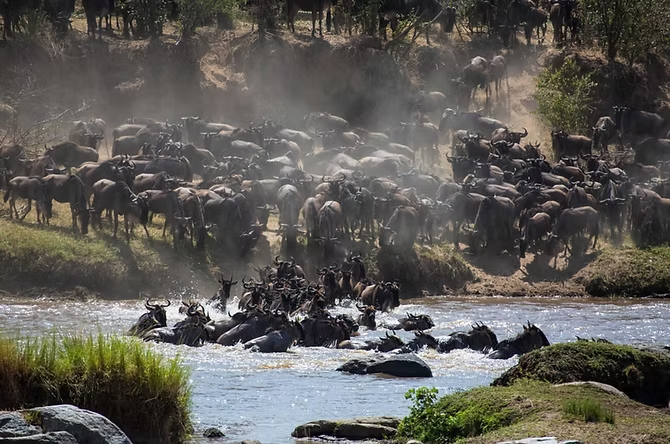
Seasonal Wildlife Migration in Serengeti
The Serengeti is one of the world’s most remarkable wildlife ecosystems, famous for the annual movement of millions of animals across its vast plains and woodlands. When people hear the word migration, they often think only of the spectacular wildebeest herds. In reality, seasonal wildlife migration in the Serengeti is a much broader ecological process involving wildebeest, zebra, gazelles, predators, birds and many other species.
The movement of wildlife is strongly connected to rainfall, fresh grass, water and breeding conditions. As the seasons change, animals respond by moving toward areas where food and water are most suitable.
This creates a constantly changing wildlife landscape across southern, central, western and northern Serengeti.
What Is Seasonal Wildlife Migration?
Seasonal wildlife migration is the regular movement of animals between different areas of an ecosystem in response to changing environmental conditions.
In Serengeti, rainfall is one of the most important factors controlling this movement.
When rain falls, grass grows.
When fresh grass becomes available, large herbivores move toward it.
As the grass is consumed and conditions change, the animals continue moving in search of better grazing and water.
The result is a huge annual cycle rather than a single migration event.
This is why the Serengeti can offer excellent wildlife experiences throughout the year, even though different areas become more important during different seasons.
The Great Serengeti Wildlife Cycle
The annual wildlife cycle can broadly be divided into several stages:
Southern Serengeti and Ndutu → Central Serengeti → Western Corridor → Northern Serengeti → Southern Serengeti
The exact route is never perfectly fixed.
Different herds can move at different speeds, divide into smaller groups or remain in particular areas depending on local rainfall and availability of food.
This natural variation is one of the reasons every Serengeti safari can be different.
January: Wildlife Concentrates in the Southern Serengeti
January is generally an important period for the southern Serengeti and the Ndutu region.
Following seasonal rains, fresh grass becomes available across the short-grass plains.
Large concentrations of wildebeest and zebra gather in the area.
The abundance of grazing animals creates excellent conditions for predators.
Visitors may encounter lions, cheetahs, hyenas and other carnivores following the herds.
January is therefore not simply a migration month. It is part of the reproductive and ecological cycle of the ecosystem.
February: The Calving Season
February is widely associated with the peak of the wildebeest calving season in the southern Serengeti and Ndutu area, although the precise timing varies from year to year.
Thousands of calves can be born during the calving period.
This dramatically increases predator activity.
Lions, cheetahs, hyenas and other predators take advantage of the abundance of vulnerable young animals.
For wildlife enthusiasts, the calving season provides opportunities to observe:
- Newborn wildebeest
- Zebra with young
- Predator activity
- Mother-and-calf behaviour
- Large grazing herds
- Birds of prey
- Dramatic predator-prey interactions
The southern Serengeti is therefore one of the most important seasonal wildlife areas in Tanzania during the early part of the year.
March: The Herds Begin Preparing to Move
By March, the calving season may still be underway, but environmental conditions gradually begin to change.
As the grass is consumed and rainfall patterns shift, large herds begin moving away from the southern plains.
Some animals remain in the area for longer, while others begin their journey northward.
This creates an interesting transitional period when visitors can experience both large concentrations of wildlife and the beginning of the northward migration.
April: Movement Toward Central Serengeti
April is part of the transition toward central Serengeti.
The herds begin spreading out as they search for fresh grazing.
The central Serengeti, including the Seronera area, can be productive for general wildlife viewing throughout the year.
Resident animals such as lions, leopards, elephants, giraffes, buffalo and various antelope remain in the region even when migratory herds move elsewhere.
This distinction between migratory wildlife and resident wildlife is important.
Not every animal in Serengeti migrates.
Many species maintain territories or home ranges throughout the year.
May: The Long Northward Journey
May is often associated with the beginning of a major northward movement.
Large herds travel through central Serengeti and toward the Western Corridor.
The landscape can be particularly attractive during and after the rains, with green vegetation and abundant wildlife.
The movement may appear as enormous columns of wildebeest and zebra crossing open plains.
However, the herds do not necessarily travel as one enormous group.
Different sections of the migration can be spread over many kilometres.
June: Western Serengeti and the Grumeti Region
By June, the Western Corridor and Grumeti Region can become increasingly important.
The migrating herds encounter different landscapes as they move west and north.
The Grumeti River is one of the major geographical features along this part of the journey.
Large concentrations of wildebeest and zebra may gather near water and river crossings.
The region also supports resident predators and other wildlife.
For travellers, June can therefore provide a combination of migration viewing and excellent general game viewing.
July: Northern Movement
During July, increasing numbers of animals may continue northward toward northern Serengeti.
Some herds can remain in the Western Corridor, while others move through central and northern areas.
This is an important reminder that there is no single migration timetable.
One section of the herd may be crossing a river while another group is still grazing hundreds of kilometres away.
Northern Serengeti becomes increasingly important as the migration progresses.
August: Northern Serengeti and the Mara River
August is commonly associated with the migration in northern Serengeti.
Some herds may reach the Mara River, where they face one of the most famous obstacles of their annual journey.
River crossings can be dramatic, but they are unpredictable.
Animals may gather for hours before crossing.
They may suddenly turn back.
A smaller group may cross at a different location.
Some groups may cross successfully while others continue along alternative routes.
The Mara River should therefore be viewed as one part of the migration rather than the destination of the migration itself.
September: Wildlife in Northern Serengeti
September can continue to provide excellent wildlife viewing in northern Serengeti.
Large herds may remain in the north, while resident wildlife continues to occupy the ecosystem.
The combination of migratory animals and permanent wildlife populations creates a diverse safari experience.
Visitors may see:
- Wildebeest
- Zebra
- Giraffes
- Elephants
- Buffalo
- Lions
- Leopards
- Cheetahs
- Hyenas
- Hippos
- Crocodiles
- Numerous bird species
The exact distribution of the migratory herds depends heavily on local conditions.
October: Beginning of the Southward Movement
Around October, rainfall patterns begin changing again.
Some herds start moving southward.
The animals gradually retrace the broad ecological cycle toward Tanzania’s southern Serengeti.
The migration does not happen overnight.
Different groups move at different speeds.
Some may remain in northern Serengeti while others have already travelled south.
This transition can make October an interesting month for travellers who want to experience wildlife movement without focusing exclusively on river crossings.
November: Return to Southern Serengeti
The short rains in November often contribute to the southward movement.
Fresh vegetation begins appearing in parts of the southern Serengeti.
The herds respond to these changing conditions.
The annual cycle begins coming full circle as wildebeest and zebra return toward the southern plains.
Predators continue following the movement of prey, while resident wildlife remains distributed throughout the ecosystem.
December: Preparing for the Next Cycle
By December, increasing numbers of wildebeest may be moving into the southern Serengeti.
Fresh grass becomes increasingly important as the next calving season approaches.
The landscape gradually prepares for another cycle.
The same ecological process that brought the herds south the previous year begins again.
This is why the Serengeti migration is better understood as a continuous annual cycle rather than a once-a-year event.
Zebra and Gazelle Migration
Wildebeest receive most of the attention, but zebra and gazelles are important participants in the wider seasonal movement.
Large numbers of zebra often travel alongside wildebeest.
Different species have different feeding requirements, which means they can use the same landscape in complementary ways.
Thomson’s gazelles and other antelopes may also move seasonally, although their patterns are not identical to those of wildebeest.
Together, these herbivores form a massive seasonal movement of grazing animals.
Predators Follow the Seasonal Abundance of Prey
Predators do not migrate in the same way as wildebeest.
Many remain resident in particular territories.
However, the seasonal concentration of prey strongly influences where predators can find feeding opportunities.
This is especially obvious during the calving season.
Large numbers of young wildebeest provide opportunities for predators, while later in the year the huge concentrations of adults create other feeding opportunities.
The migration therefore affects the behaviour and distribution of predators across the Serengeti.
Lions
Lions are among the most commonly encountered predators in the Serengeti.
They are capable of hunting resident prey throughout the year but can benefit significantly from seasonal concentrations of migrating herbivores.
Cheetahs
Cheetahs are particularly associated with open grassland environments.
The southern plains during the calving period can provide interesting opportunities for observing cheetahs and other predators.
Hyenas
Spotted hyenas are highly adaptable predators and scavengers.
They interact with both resident wildlife and migrating herds.
Leopards
Leopards are generally more secretive and are associated with woodland and riverine habitats.
Their distribution does not simply follow the wildebeest migration.
Birds and Seasonal Wildlife Movement
Birdlife also responds to seasonal changes in the Serengeti.
Rainfall influences vegetation, insects, water availability and breeding conditions.
Migratory birds from other parts of Africa and beyond can also occur in the ecosystem during different periods of the year.
This means a Serengeti safari is not only about large mammals.
The changing seasons can produce different birding opportunities as well.
Resident Wildlife vs Migratory Wildlife
One of the most important things to understand about Serengeti is that the ecosystem remains active even when the migration moves elsewhere.
Resident wildlife includes animals that do not participate in the large annual wildebeest movement.
These can include:
- Lions
- Leopards
- Elephants
- Giraffes
- Buffalo
- Hippos
- Many antelope species
- Numerous bird species
Consequently, there is no period when the Serengeti simply becomes empty.
Instead, the composition and concentration of wildlife changes from one region and season to another.
The Role of Rainfall
Rainfall is one of the main forces behind seasonal wildlife movement.
The Serengeti experiences changing rainfall patterns, and these influence where fresh grass appears.
Wildebeest have evolved to exploit these changing conditions.
The animals essentially move through the ecosystem in search of the best combination of food and water.
This relationship explains why migration dates cannot be predicted with absolute precision.
A safari operator may know the broad seasonal pattern, but no one can guarantee the exact location of a particular herd on a specific day months in advance.
Water and the Migration
Water is another important factor.
During wetter periods, temporary water sources become available across the plains.
During drier periods, permanent rivers and waterholes become increasingly valuable.
The distribution of water influences both herbivores and predators.
Rivers such as the Grumeti and Mara become particularly important geographical features during the northward movement.
Why the Serengeti Migration Is Not a Straight Line
It is tempting to imagine the migration as a straight line from south to north and back again.
The reality is much more complicated.
The herds spread across a huge landscape.
Some groups move quickly.
Others stop to graze.
Some turn in response to rain.
Others remain behind.
The migration is therefore better described as a moving network of wildlife across a seasonal landscape.
Seasonal Wildlife Migration by Region
| Serengeti Region | Main seasonal significance |
|---|---|
| Southern Serengeti / Ndutu | Calving and wet-season grazing |
| Central Serengeti | Year-round resident wildlife and transitional migration |
| Western Corridor / Grumeti | Northward migration and river ecosystem |
| Northern Serengeti | Later northward migration and Mara River region |
| Eastern Serengeti | Important grasslands and wildlife habitats |
| Southern Serengeti | Return movement and preparation for calving |
Each region contributes something different to the annual wildlife cycle.
Best Time to Experience Seasonal Wildlife Movement
There is no single best month for every type of wildlife experience.
Instead, the ideal period depends on what you want to see.
| Season | What you may experience |
|---|---|
| January–March | Southern plains, calving and predator activity |
| April–May | Green landscapes and northward movement |
| June–July | Western Corridor and Grumeti migration |
| August–September | Northern Serengeti and possible Mara River crossings |
| October–December | Southward movement and return to southern plains |
These periods are approximate because weather conditions can change the timing and location of wildlife.
Planning a Seasonal Serengeti Safari
A safari designed around seasonal migration should allow some flexibility.
Rather than planning the entire trip around one predicted event, consider combining several Serengeti regions.
For example:
Arusha → Ngorongoro → Southern Serengeti → Central Serengeti → Western Corridor → Northern Serengeti
This provides opportunities to experience different ecological stages.
During January to March, more time can be allocated to the southern Serengeti.
During June and July, the Western Corridor can become a major focus.
During August and September, northern Serengeti may become more relevant.
Self-Drive Seasonal Wildlife Safari
The Serengeti can also form part of a self-drive 4×4 safari for experienced travellers.
Self-driving provides flexibility to spend more time in areas where wildlife is active.
However, travellers need to understand park regulations, road conditions, wildlife-viewing rules and camping requirements before entering the park.
A properly equipped 4×4 is particularly useful for longer safari routes.
For travellers using a 4×4 with a rooftop tent, Serengeti can be incorporated into a broader Tanzania camping adventure covering Tarangire, Ngorongoro and other northern destinations.
The most important principle is to remain flexible.
Migration is dynamic, so a rigid itinerary based on an exact predicted location may not work as expected.
Responsible Wildlife Viewing
Seasonal wildlife concentrations can attract many safari vehicles, particularly around famous migration events.
Responsible viewing is therefore important.
Visitors should:
- Maintain a safe distance from animals.
- Avoid blocking migration routes.
- Never chase or harass wildlife.
- Follow park speed and driving regulations.
- Remain on permitted roads and tracks.
- Follow instructions from guides and park authorities.
- Avoid disturbing animals during sensitive encounters.
Protecting natural behaviour is essential to preserving the migration experience for future generations.
Why Seasonal Migration Makes Serengeti Special
The greatest attraction of Serengeti is not simply the number of animals.
It is the fact that the ecosystem is constantly changing.
One month, the southern plains may be filled with newborn wildebeest.
Several months later, the Western Corridor may contain enormous moving herds.
Later still, northern Serengeti may become the centre of migration activity.
Eventually, the animals begin moving south again.
The landscape changes.
The grass changes.
The water changes.
The wildlife changes.
Yet the ecological cycle continues.
Experience the Serengeti Through the Seasons
A safari to Serengeti can be planned around a particular wildlife event, but understanding the seasonal cycle makes the experience even more rewarding.
The calving season tells the story of reproduction.
The northward migration tells the story of movement and survival.
The Grumeti and Mara rivers introduce natural obstacles.
The northern season reveals the concentration of wildlife around water and grazing areas.
The southward migration completes the annual cycle.
Together, these stages form one of the world’s greatest wildlife spectacles.
Frequently Asked Questions
Does wildlife migrate throughout the Serengeti all year?
Yes. The most famous wildebeest migration is a continuous annual cycle. Different areas become important at different times depending mainly on rainfall, grass and water.
What animals migrate in Serengeti?
Wildebeest are the dominant migratory species, accompanied by large numbers of zebra and several species of gazelle and other herbivores.
When is the Serengeti migration?
The migration occurs throughout the year. The herds generally concentrate in the south during the calving season, move north through central and western Serengeti, reach the northern areas later in the year, and then move south again.
Is the migration predictable?
Only broadly. Seasonal patterns are well understood, but the exact location and timing of herds depend on rainfall and local environmental conditions.
What is the best month for wildlife migration?
It depends on the experience you want. January to March is associated with calving, June to July with the Western Corridor and Grumeti region, and August to September with northern Serengeti and possible Mara River activity.
Can I see wildlife outside migration season?
Yes. Serengeti has substantial resident wildlife throughout the year, including lions, elephants, giraffes, buffalo, leopards and many other species.
Is Ngorongoro part of the migration?
The wider Ngorongoro landscape, particularly the southern Serengeti–Ndutu area, is closely connected to the early part of the migration and calving cycle. The famous Ngorongoro Crater itself is not the main migration route.
Can I combine different migration seasons in one safari?
A longer safari can combine several regions, but the migration’s timing means that travellers should choose dates based on the seasonal experience they want rather than attempting to experience every stage in a single short trip.
Conclusion
Seasonal wildlife migration in Serengeti is a year-round ecological story.
From the southern plains where wildebeest gather for calving, through central Serengeti and the Western Corridor, toward the northern plains and the Mara River, and eventually back south, wildlife responds continuously to rainfall, grass and water.
The migration is therefore much more than the famous river crossings.
It is a cycle of birth, grazing, movement, survival and renewal that connects different parts of the Serengeti ecosystem.
For travellers, this means there is no single way to experience Serengeti. A February safari can reveal the drama of the calving season, a June trip can focus on the Western Corridor and Grumeti, while a later-season journey can explore northern Serengeti.
Whatever month you choose, understanding the seasonal wildlife cycle allows you to plan a safari around the natural rhythms of one of Africa’s most extraordinary ecosystems.