
Umbwe Route Kilimanjaro: Complete 7-Day Climbing Guide, Itinerary, Difficulty & Summit Experience
Introduction: Discover the Challenging Umbwe Route on Mount Kilimanjaro
The Umbwe Route is one of the most challenging and adventurous ways to climb Mount Kilimanjaro, Africa’s highest mountain, standing at 5,895 metres above sea level. Located in northern Tanzania, Kilimanjaro attracts adventure travellers from around the world who dream of reaching Uhuru Peak and experiencing the extraordinary landscapes of the Roof of Africa.
Approaching from the southern side of the mountain, the Umbwe Route is famous for its steep ascent, dramatic ridges, beautiful rainforest and spectacular mountain scenery. Unlike some of the longer Kilimanjaro routes, Umbwe gains altitude relatively quickly, making it a demanding option that requires good physical preparation and careful acclimatization.
The route begins near Umbwe Gate and climbs through dense montane rainforest before following a narrow ridge towards the higher mountain slopes. It eventually joins the southern circuit near Barranco Camp, where climbers continue towards Karanga, Barafu and the summit.
The Umbwe Route is generally completed in six or seven days. A seven-day itinerary is preferable for many climbers because it provides additional time for acclimatization compared with the shorter option.
At Graceland Adventurous, we organize memorable African adventures, including guided Kilimanjaro climbs, wildlife safaris and East African trekking holidays.
Whether you are an experienced hiker or an adventurous traveller seeking a demanding mountain challenge, we can help you plan your Umbwe Route Kilimanjaro climbing adventure.
Where Does the Umbwe Route Start?
The Umbwe Route approaches Mount Kilimanjaro from the southern side. The climb begins at Umbwe Gate, which is accessed by road from the Moshi area.
After completing park registration and meeting your mountain crew, you begin trekking through the lush montane rainforest.
The trail initially follows a steep ridge through dense vegetation before gradually opening into heathland and moorland as you gain elevation.
The route continues towards Barranco Camp, where it joins the southern circuit used by other Kilimanjaro climbing routes.
From Barranco, climbers cross the famous Barranco Wall and continue towards Karanga Camp and Barafu Camp before attempting the summit.
After reaching Uhuru Peak, the descent normally follows the Mweka Route, finishing at Mweka Gate.
This southern approach offers a memorable combination of rainforest, steep mountain ridges, rocky landscapes and spectacular views of Kibo Peak.
Why Choose the Umbwe Route for Climbing Kilimanjaro?
The Umbwe Route is particularly attractive to experienced hikers and adventurous travellers looking for a more demanding approach to Mount Kilimanjaro.
One of its main attractions is the steep and direct ascent through the southern rainforest. The early stages are physically demanding, with narrow trails, significant elevation gain and impressive views of the surrounding mountain environment.
Another advantage is the dramatic scenery. The route follows a ridge through the forest before opening into higher-altitude landscapes with views towards the southern slopes of Kibo.
Umbwe is also generally quieter during its initial stages than some of the more popular climbing routes. Once it joins the southern circuit near Barranco, however, climbers share sections of the trail and campsites with other groups.
The route is shorter than the Northern Circuit and Lemosho options, but its steep profile makes it physically demanding. Climbers should not mistake its shorter duration for an easier climb.
For travellers with suitable trekking experience who want a challenging approach to the Roof of Africa, Umbwe offers a distinctive mountain adventure.
Umbwe Route Kilimanjaro: Complete 7-Day Itinerary
The following itinerary describes a seven-day Umbwe Route climb, beginning at Umbwe Gate and descending through Mweka Gate. Camp arrangements and daily stages can vary between operators.
Day 1: Umbwe Gate to Umbwe Cave Camp
Elevation: Approximately 1,600 metres to 2,850 metres
Hiking distance: Approximately 8 kilometres
Hiking time: 5–7 hours
Vegetation zone: Montane rainforest
Your Kilimanjaro adventure begins with a transfer from your hotel in Moshi or Arusha to Umbwe Gate.
After completing park registration and meeting your mountain crew, you begin the trek through the beautiful montane rainforest.
The trail climbs steeply along a narrow ridge, passing through thick vegetation and tall forest trees. Compared with some other Kilimanjaro routes, the Umbwe approach gains elevation quickly, making the first day physically demanding.
The forest provides a beautiful natural environment, with opportunities to observe birds and other wildlife along the trail.
As you continue climbing, the vegetation gradually becomes less dense and the terrain more exposed.
After several hours of trekking, you arrive at Umbwe Cave Camp, where your mountain crew prepares the campsite and dinner.
Take time to rest, hydrate and prepare for the next stage of the climb.
Overnight at Umbwe Cave Camp.
Day 2: Umbwe Cave Camp to Barranco Camp
Elevation: Approximately 2,850 metres to 3,960 metres
Hiking distance: Approximately 6 kilometres
Hiking time: 4–6 hours
Vegetation zone: Heathland and moorland
After breakfast, you leave Umbwe Cave Camp and continue climbing along the mountain ridge.
The trail gradually leaves the dense rainforest behind as you enter open heathland and moorland.
The route remains steep in places, with rocky sections and exposed viewpoints offering impressive views of the surrounding valleys and mountain slopes.
As you gain altitude, the landscape changes and the impressive southern glaciers and western mountain formations may become visible in favourable weather.
The trail eventually descends towards Barranco Camp, located in the beautiful Barranco Valley beneath the famous Barranco Wall.
Barranco is one of the most scenic campsites on Kilimanjaro. It provides an excellent opportunity to rest and enjoy views of the surrounding mountain landscape.
Overnight at Barranco Camp.
Day 3: Barranco Camp to Karanga Camp
Elevation: Approximately 3,960 metres to 4,035 metres
Hiking distance: Approximately 5 kilometres
Hiking time: 4–5 hours
The third day begins with one of the most memorable sections of the Kilimanjaro climb: the famous Barranco Wall.
After breakfast, you begin climbing the steep rocky wall. Although it looks intimidating from below, most climbers with reasonable fitness can complete this section with guidance from their mountain guides.
The ascent involves scrambling over rocks rather than technical rock climbing.
Once you reach the top, you are rewarded with impressive views of the mountain valleys and surrounding peaks.
The trail then continues through a series of ascents and descents before reaching Karanga Camp.
Although the distance is relatively short, the terrain and altitude make the day physically demanding.
Upon arrival, you have time to rest, enjoy your meals and prepare for the next stage.
Overnight at Karanga Camp.
Day 4: Karanga Camp to Barafu Camp
Elevation: Approximately 4,035 metres to 4,640 metres
Hiking distance: Approximately 4 kilometres
Hiking time: 3–5 hours
Vegetation zone: Alpine desert
After breakfast, you continue towards Barafu Camp, the final base camp before the summit attempt.
The trail climbs through increasingly dry and rocky alpine desert terrain.
Although the walking distance is relatively short, the altitude makes the journey physically demanding. Your guide will encourage a slow and steady pace to help you manage the conditions.
Upon reaching Barafu Camp, you have time to rest, enjoy an early dinner and prepare your clothing and equipment for the summit attempt.
Your mountain guide will explain the summit schedule and provide important safety instructions.
The summit climb normally begins around midnight, although the exact departure time depends on the operator’s arrangements and mountain conditions.
Overnight at Barafu Camp.
Day 5: Barafu Camp to Uhuru Peak and Mweka Camp
Elevation: Approximately 4,640 metres to 5,895 metres, descending to approximately 3,100 metres
Hiking distance: Approximately 16–20 kilometres
Hiking time: Approximately 10–14 hours or longer
This is the most challenging and rewarding day of your Umbwe Route adventure.
You normally begin climbing around midnight, accompanied by your mountain guide and assistant guides.
The trail follows steep volcanic scree slopes towards Stella Point, located on the crater rim at approximately 5,756 metres.
The climb is physically demanding because of the high altitude, cold temperatures and steep terrain.
Your guides maintain a slow and steady walking pace to help you manage the difficult conditions.
After reaching Stella Point, you continue along the crater rim towards Uhuru Peak.
At 5,895 metres, Uhuru Peak is the highest point in Africa.
Reaching the summit is an unforgettable achievement. You are standing on the Roof of Africa, surrounded by spectacular views of glaciers, volcanic landscapes and the vast African plains below.
After celebrating your achievement and taking photographs, you begin descending towards Barafu Camp for a short rest before continuing to Mweka Camp.
Overnight at Mweka Camp.
Day 6: Mweka Camp to Mweka Gate
Elevation: Approximately 3,100 metres to 1,640 metres
Hiking distance: Approximately 10 kilometres
Hiking time: 3–5 hours
Vegetation zone: Montane rainforest
After breakfast, you begin the final descent through the lush montane rainforest towards Mweka Gate.
The lower slopes are generally warmer and more humid, offering a pleasant contrast to the cold conditions experienced during the summit attempt.
The trail passes through beautiful forest vegetation before reaching the park exit.
At Mweka Gate, you complete the park exit formalities and receive your Kilimanjaro climbing certificate if you successfully reached the summit.
Your driver will be waiting to transfer you back to your hotel in Moshi or Arusha.
Your Umbwe Route Kilimanjaro adventure comes to an end.
Important: The itinerary above is a six-day mountain schedule within a seven-day travel arrangement if an additional arrival or departure day is included. Operators may also offer a seven-day mountain itinerary with an additional acclimatization day. Confirm the exact number of trekking days and overnight camps when requesting a quotation.
Umbwe Route: 6 Days or 7 Days?
The Umbwe Route is commonly offered as a six-day or seven-day climb, depending on the itinerary.
The six-day option is shorter and involves a relatively rapid ascent. Because Umbwe is already a steep route, the shorter schedule provides limited time for acclimatization and is generally best considered by climbers with suitable high-altitude trekking experience.
The seven-day option allows an additional day for acclimatization, commonly arranged around the southern circuit. This provides more time to adjust to the increasing altitude before the summit attempt.
For most travellers, we recommend considering the longer itinerary rather than choosing the shortest available schedule.
Additional time can improve the opportunity for altitude adaptation, although it does not eliminate the risk of altitude sickness or guarantee reaching Uhuru Peak.
How Difficult Is the Umbwe Route?
The Umbwe Route is considered one of the most physically demanding routes on Mount Kilimanjaro.
Its steep initial ascent is one of its defining characteristics. Climbers gain elevation quickly while walking along narrow ridges and rocky trails through the rainforest and higher mountain zones.
Unlike routes with a more gradual approach, Umbwe requires climbers to manage significant elevation gain during the early stages of the journey.
The famous Barranco Wall, the high-altitude approach to Barafu Camp and the final summit climb add further challenges.
Altitude is another major consideration. As climbers approach 5,895 metres, reduced oxygen availability makes even ordinary walking more difficult.
Good physical fitness is essential, but fitness alone does not guarantee successful acclimatization.
We encourage climbers to walk slowly, drink sufficient water, eat regularly and communicate any symptoms of altitude sickness to their guides immediately.
Because of its steep profile and relatively rapid ascent, Umbwe is generally not the first recommendation for inexperienced high-altitude trekkers.
Umbwe Route Accommodation: Mountain Camping Experience
The Umbwe Route is a camping route, meaning climbers sleep in mountain tents at designated campsites throughout the journey.
Unlike the Marangu Route, which offers permanent mountain huts, Umbwe provides a traditional mountain camping experience.
Your mountain crew normally handles tent setup, campsite preparation and meal arrangements.
A typical climbing package includes sleeping tents, a dining tent, sleeping mattresses, dining equipment and meals prepared by the mountain cook.
The campsites are located in different ecological zones, allowing climbers to experience the changing mountain environment.
At higher elevations, temperatures can become extremely cold, especially during the summit attempt.
A suitable sleeping bag, warm clothing and proper camping equipment are therefore essential.
What Is Included in an Umbwe Route Kilimanjaro Package?
A professionally organized Umbwe Route climbing package normally includes:
- Kilimanjaro National Park entrance fees.
- Applicable camping and conservation fees.
- Experienced English-speaking mountain guides.
- Professional mountain porters.
- Mountain cook and prepared meals.
- Drinking water during the climb, subject to the operator’s arrangements.
- Sleeping tents and dining equipment.
- Sleeping mattresses, according to the package.
- Transfers between your hotel and the mountain gates.
- Rescue and emergency support arrangements provided under park regulations.
- Applicable government taxes and levies.
Items that may be excluded include international flights, travel insurance, personal hiking equipment, sleeping bags, hotel accommodation before and after climbing, tips for the mountain crew and personal expenses.
Always request a detailed quotation confirming the exact inclusions and exclusions before booking.
How Much Does the Umbwe Route Kilimanjaro Climb Cost?
The cost of climbing Kilimanjaro through the Umbwe Route depends on the number of trekking days, group size, travel season, accommodation arrangements and level of service included.
A seven-day climb generally costs more than a six-day option because it involves additional park-related expenses, meals and mountain crew arrangements.
Private climbs are normally more expensive per person than joining a scheduled group departure.
Although Umbwe is a shorter route than Lemosho or the Northern Circuit, its logistical requirements and steep approach should be considered when comparing prices.
When comparing Kilimanjaro climbing packages, travellers should consider the quality of mountain guides, porter welfare, food, camping equipment, safety procedures and the services included in the quotation.
Contact Graceland Adventurous for assistance with planning your Umbwe Route adventure and requesting an updated climbing quotation.
What to Pack for the Umbwe Route
Preparing the correct equipment is essential for a comfortable and safe Kilimanjaro climb.
The mountain experiences different climatic conditions, ranging from warm tropical rainforest to freezing summit temperatures.
Important items include:
Clothing: Thermal base layers, fleece jackets, an insulated down jacket, waterproof jacket, waterproof trousers, hiking trousers, warm socks, gloves and a warm hat.
Footwear: Comfortable waterproof hiking boots, camp shoes and gaiters.
Personal equipment: A comfortable daypack, trekking poles, headlamp, sunglasses, sunscreen, water bottles or hydration system and a suitable sleeping bag.
Personal supplies: Toiletries, personal medication, blister treatment, snacks and a small first-aid kit.
Your main duffel bag will generally be carried by porters, while your daypack should contain the equipment and supplies you need during the daily hike.
Your operator should provide a detailed packing list before departure.
How to Prepare Physically for Climbing the Umbwe Route
Physical preparation is particularly important for anyone planning to climb Kilimanjaro through the Umbwe Route.
We recommend starting training several months before your planned climb.
Regular hiking is one of the best ways to prepare. Include longer walks, steep uphill trails and hikes carrying a light backpack.
Cardiovascular activities such as cycling, swimming, jogging and walking can also help improve endurance.
Because the Umbwe Route has a steep initial ascent, training on uphill terrain and uneven trails can be particularly useful.
If possible, practise hiking on consecutive days while wearing the boots you intend to use on Kilimanjaro.
It is equally important to understand the effects of altitude. Even physically fit climbers can experience altitude sickness.
Following your guide’s acclimatization instructions, walking slowly and communicating any health concerns are essential parts of the journey.
Is the Umbwe Route Suitable for Beginners?
The Umbwe Route is generally not the best choice for first-time mountain climbers or travellers without previous high-altitude trekking experience.
Its steep initial ascent and relatively rapid elevation gain make it more demanding than routes with longer, gradual approaches.
Beginners who want to climb Kilimanjaro may find the Lemosho, Machame or Northern Circuit routes more suitable, particularly when choosing an itinerary with additional acclimatization time.
However, a beginner with strong physical preparation and an appropriate longer itinerary may still consider Umbwe after discussing the challenges with an experienced operator.
The route does not require technical mountaineering skills, but climbers should be comfortable with demanding hiking conditions and the effects of altitude.
What Is the Best Time to Climb the Umbwe Route?
Mount Kilimanjaro can be climbed throughout the year, although some months generally offer better trekking conditions than others.
January to early March: This period generally offers favourable weather conditions, relatively warm temperatures and good opportunities for mountain views.
June to October: These are popular climbing months because they generally experience drier conditions. July, August and September are particularly busy.
November to December: Short rains may occur, especially in November, although climbing is still possible with appropriate preparation.
April and May: These months experience the main rainy season. Trails can become wet and slippery, and cloud cover may affect visibility.
For travellers looking for a combination of favourable weather and good trekking conditions, January, February, July, August, September and early October are popular choices.
Regardless of the season, weather conditions can change quickly on Kilimanjaro. Climbers should be prepared for rain, strong winds and freezing temperatures at higher elevations.
Combining the Umbwe Route with a Tanzania Safari
One of the advantages of climbing Kilimanjaro is the opportunity to combine your mountain adventure with a wildlife safari in northern Tanzania.
After completing your climb, you can relax in Moshi or Arusha before exploring some of Tanzania’s most famous national parks.
Tarangire National Park is famous for its large elephant populations, impressive baobab trees and diverse wildlife.
Lake Manyara National Park offers beautiful scenery, birdlife and opportunities to see elephants, giraffes, zebras and other animals.
Ngorongoro Crater is one of Africa’s most remarkable wildlife destinations, with opportunities to see lions, elephants, buffaloes and endangered black rhinos.
Serengeti National Park is famous for its extensive savannah plains, large predator populations and the Great Wildebeest Migration.
Travellers with additional time can also extend their adventure to Zanzibar for a relaxing beach holiday.
Explore our Tanzania wildlife safaris, East Africa safari tours, Uganda wildlife safaris and Rwanda safari adventures to create a complete African travel experience.
Explore More African Adventures with Graceland Adventurous
Graceland Adventurous helps travellers discover some of Africa’s most exciting destinations through mountain trekking, wildlife encounters and unforgettable safari experiences.
Beyond Mount Kilimanjaro, you can explore several other exciting adventures across East Africa.
- Uganda Gorilla Trekking: Experience an unforgettable encounter with mountain gorillas in Bwindi Impenetrable National Park or Mgahinga Gorilla National Park.
- Rwanda Gorilla Trekking: Discover the remarkable mountain gorillas of Volcanoes National Park.
- Akagera National Park Self-Drive Safari: Explore Rwanda’s beautiful savannah landscapes and wildlife with a self-drive safari adventure.
- Uganda Wildlife Safaris: Discover national parks, diverse wildlife and spectacular natural landscapes.
- Rwanda Wildlife Safaris: Experience wildlife viewing in Akagera National Park, including opportunities to see lions, elephants, rhinos and giraffes.
- Tree-Climbing Lions in East Africa: Discover the fascinating tree-climbing lions of Queen Elizabeth National Park in Uganda and Lake Manyara National Park in Tanzania.
Whether you are interested in African mountain climbing adventures, gorilla trekking in East Africa or self-drive African safaris, Graceland Adventurous can help you explore different destinations and experiences.
Umbwe Route vs Machame Route: Which Kilimanjaro Route Is Better?
Both the Umbwe and Machame routes approach Kilimanjaro from the southern side and eventually connect with the southern circuit.
However, their early trekking experiences are quite different.
The Umbwe Route follows a steep ridge through the rainforest and gains elevation relatively quickly. It is known for its demanding approach and is generally recommended for climbers with suitable trekking experience.
The Machame Route follows a more gradual approach through the southern rainforest before crossing the Shira Plateau and continuing towards Lava Tower and Barranco Camp.
Machame is generally completed in six or seven days, while Umbwe is commonly offered as a six- or seven-day climb.
Both routes use mountain camping accommodation and descend through Mweka Gate.
Travellers looking for a demanding and direct approach may consider Umbwe, while those seeking a more gradual ascent and additional itinerary choices may prefer Machame.
Umbwe Route vs Lemosho Route: What Is the Difference?
The Umbwe and Lemosho routes offer two very different ways to experience Mount Kilimanjaro.
Umbwe begins on the southern side and follows a steep ridge through rainforest before joining the southern circuit near Barranco Camp.
Lemosho approaches from the western side, beginning at Londorossi Gate and crossing the beautiful Shira Plateau before joining the southern circuit.
Lemosho generally takes seven or eight days, while Umbwe is commonly completed in six or seven days.
Both routes offer spectacular scenery and mountain camping, but Lemosho provides a longer and generally more gradual approach.
Travellers with enough time who want more opportunities for acclimatization may prefer Lemosho. Those seeking a steep and challenging route may be interested in Umbwe.
Umbwe Route vs Northern Circuit: Which Should You Choose?
The Umbwe and Northern Circuit routes are among the most contrasting ways to climb Mount Kilimanjaro.
Umbwe is known for its steep southern approach and relatively short climbing schedule. It is a demanding option for climbers who want a direct ascent through the rainforest and southern mountain slopes.
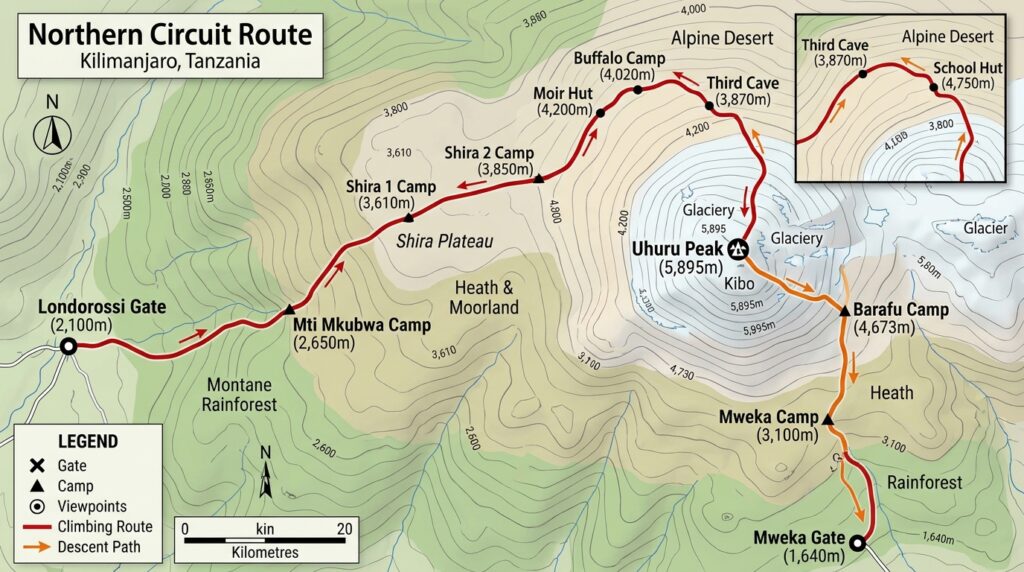
The Northern Circuit begins on the western side of Kilimanjaro and follows an extended route around the northern slopes before approaching the summit.
The Northern Circuit generally takes nine days, providing more time for acclimatization and opportunities to experience remote mountain scenery.
Umbwe is suitable for climbers seeking a challenging and direct approach, while the Northern Circuit is often more attractive to travellers who prefer a longer itinerary and gradual altitude adaptation.
For most first-time climbers, the Northern Circuit is generally the more suitable of these two options because of its longer duration.
Why Choose Graceland Adventurous?
Graceland Adventurous is focused on creating memorable African travel experiences through carefully planned adventures, wildlife exploration and mountain trekking.
Our destination experiences cover some of East Africa’s most remarkable attractions, including Mount Kilimanjaro, Uganda’s mountain gorilla habitats, Rwanda’s Volcanoes National Park and Akagera National Park.
We help travellers explore different adventure opportunities, from challenging mountain climbs to wildlife safaris and independent road trips.
Whether you are planning your first Kilimanjaro climb or a wider East African adventure, we can help you discover experiences that match your interests and travel plans.
Frequently Asked Questions About the Umbwe Route Kilimanjaro
1. How many days does the Umbwe Route take?
The Umbwe Route is commonly offered as a six- or seven-day climb. A longer itinerary is generally preferable because it provides additional time for acclimatization.
2. Where does the Umbwe Route start?
The route begins at Umbwe Gate on the southern side of Mount Kilimanjaro, after park registration and the required entry formalities.
3. Where does the Umbwe Route finish?
The descent normally follows the Mweka Route and finishes at Mweka Gate on the southern side of Kilimanjaro.
4. What is the highest point on the Umbwe Route?
The highest point is Uhuru Peak, at 5,895 metres above sea level.
5. Is the Umbwe Route difficult?
Yes. Umbwe is one of the more physically demanding Kilimanjaro routes because of its steep initial ascent, rapid elevation gain and challenging high-altitude sections.
6. Is the Umbwe Route suitable for beginners?
It is generally not the first recommendation for beginners. First-time climbers may prefer a longer and more gradual route such as Lemosho or the Northern Circuit.
7. Is the Umbwe Route the steepest Kilimanjaro route?
Umbwe is widely regarded as one of the steepest and most direct approaches to Kilimanjaro. Its early trail follows a demanding ridge through the rainforest.
8. Does the Umbwe Route offer mountain hut accommodation?
No. The Umbwe Route is primarily a camping route, with climbers sleeping in tents at designated mountain campsites.
9. What is the success rate of the Umbwe Route?
Summit success rates vary according to itinerary length, weather, operator, climber health and acclimatization. The shorter Umbwe schedules can be challenging because of the rapid ascent. No operator can guarantee a successful summit.
10. Do I need previous climbing experience?
Previous mountaineering experience is not compulsory, but suitable trekking experience and good physical preparation are strongly recommended.
11. Can I climb the Umbwe Route alone?
You can book as a solo traveller, but Kilimanjaro climbs must be organized with the required registered mountain crew and park-authorized arrangements. Solo travellers can join scheduled group departures or arrange private climbs.
12. What happens if I experience altitude sickness?
Inform your mountain guide immediately. Depending on the severity of your symptoms, the appropriate response may include stopping the ascent, descending and arranging medical assistance or evacuation.
13. Can I combine the Umbwe Route with a Tanzania safari?
Yes. Many travellers combine their Kilimanjaro climb with a wildlife safari to Tarangire, Ngorongoro Crater and Serengeti National Park.
14. What is the best month to climb the Umbwe Route?
January, February, July, August, September and early October are popular months because they generally offer favourable trekking conditions.
15. Do I need travel insurance for the Umbwe Route?
Yes. Climbers should have travel insurance that specifically covers high-altitude trekking up to at least 6,000 metres and emergency mountain evacuation.
16. What is the difference between the Umbwe and Machame routes?
Umbwe follows a steeper and more direct southern approach, while Machame offers a more gradual route through the rainforest and across the Shira Plateau before joining the southern circuit.
17. Which is better for acclimatization: Umbwe or Lemosho?
Lemosho generally offers a more gradual approach and longer itinerary options, making it a popular choice for climbers seeking additional acclimatization time. Umbwe gains elevation more quickly during its early stages.
Book Your Umbwe Route Kilimanjaro Climbing Adventure
Reaching Uhuru Peak is more than an ordinary hiking achievement. It is an unforgettable journey through different climatic zones, spectacular mountain landscapes and one of Africa’s most extraordinary natural environments.
The Umbwe Route offers a challenging way to experience Mount Kilimanjaro, combining steep rainforest trails, dramatic mountain ridges, the famous Barranco Wall and a rewarding summit journey.
Whether you are an experienced hiker seeking a demanding mountain challenge or an adventurous traveller exploring your Kilimanjaro options, Graceland Adventurous can help you plan your trekking experience.
Contact Graceland Adventurous today to start planning your Umbwe Route Kilimanjaro climbing adventure!
Destination: Mount Kilimanjaro, Tanzania
Available options: Private climbs and group departures
Recommended duration: 7 days or longer where appropriate
Accommodation: Mountain camping
Plan your Kilimanjaro adventure and take the first step towards reaching the Roof of Africa!