
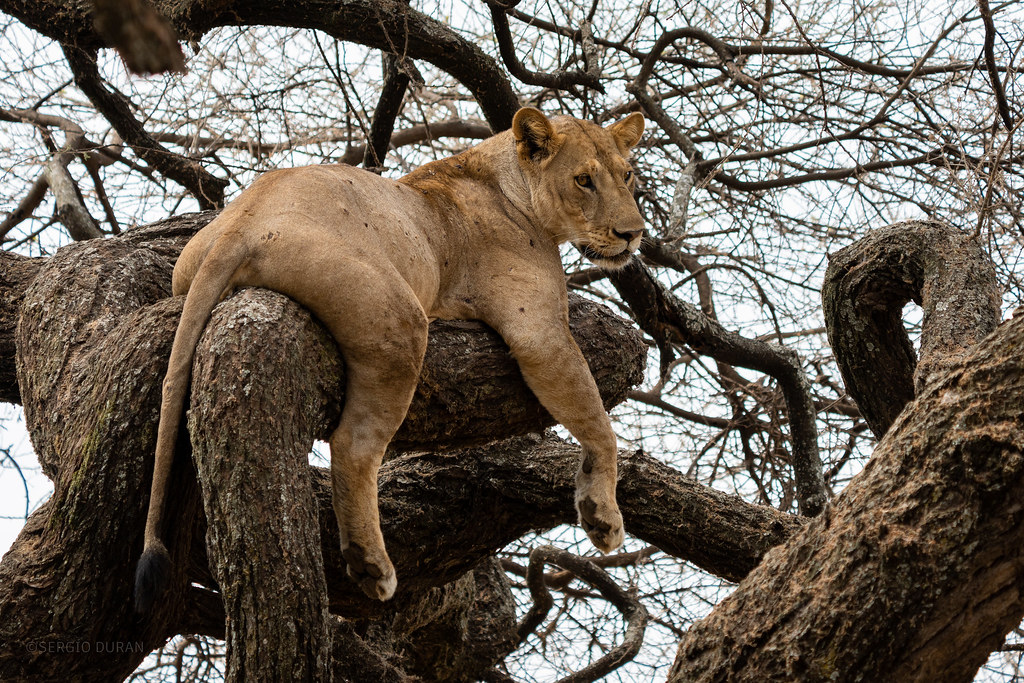
Uganda vs Tanzania Tree-Climbing Lions Safari: Comparing Ishasha and Lake Manyara National Park
Discover the differences between Uganda’s famous tree-climbing lions in Ishasha and Tanzania’s tree-climbing lions in Lake Manyara National Park. Explore their habitats, behaviour, wildlife experiences, best viewing opportunities and which destination is ideal for your African safari.
Introduction: Where Can You See Africa’s Famous Tree-Climbing Lions?
Africa is home to some of the world’s most extraordinary wildlife experiences, but few are as fascinating as watching a pride of lions resting high above the ground in the branches of a tree.
Lions are traditionally associated with open savannah grasslands, where they hunt, feed and spend much of their time resting on the ground. However, certain lion populations in East Africa have developed an unusual habit of climbing trees, making them particularly interesting to wildlife enthusiasts and safari photographers.
Two of the best-known destinations for experiencing this behaviour are Uganda’s Ishasha Sector in Queen Elizabeth National Park and Tanzania’s Lake Manyara National Park.
Both destinations offer opportunities to encounter lions resting in trees, but they provide different safari experiences. Ishasha is particularly famous for its tree-climbing lions resting in large fig trees across open savannah plains, while Lake Manyara offers a combination of tree-climbing lion encounters, groundwater forests, acacia woodlands and spectacular Rift Valley scenery.
For travellers planning an East African safari, choosing between these two destinations depends on their preferred landscapes, wildlife interests, travel routes and the other experiences they want to combine with their lion adventure.
1. Tree-Climbing Lions in Uganda: Ishasha Sector, Queen Elizabeth National Park
Uganda is one of Africa’s most famous destinations for tree-climbing lions, particularly in the Ishasha Sector of Queen Elizabeth National Park.
Located in southwestern Uganda, Ishasha occupies the southern section of Queen Elizabeth National Park, close to the border with the Democratic Republic of Congo.
The area is characterised by open savannah grasslands, scattered acacia trees, extensive fig trees and riverine vegetation. These landscapes provide suitable resting places for the lions, which are frequently associated with large fig trees.
Why Are Ishasha Lions Famous for Climbing Trees?
The Ishasha lions are particularly well known because tree climbing is an established behaviour among certain local prides.
Visitors exploring the sector may encounter lionesses, younger lions and occasionally adult males resting on broad tree branches.
Although the exact reasons behind this behaviour are not completely understood, several possible explanations have been suggested:
- Escaping biting insects found closer to the ground.
- Finding cooler resting positions during hot afternoons.
- Enjoying better airflow among tree branches.
- Getting an elevated view of the surrounding grasslands.
- Resting comfortably away from the ground.
The behaviour is also believed to be learned and passed between generations within certain prides.
Where Exactly Can You Find the Lions in Ishasha?
The search for tree-climbing lions takes place in the open woodland and savannah areas of Ishasha.
Experienced safari guides explore the tracks and check large fig trees where lions are known to rest.
The lions may be found lying across branches, sometimes several metres above the ground, while other members of the pride rest underneath the same trees.
The experience is particularly rewarding for wildlife photographers because the surrounding savannah creates beautiful photographic backgrounds.
Other Wildlife in Ishasha
Although tree-climbing lions are the main attraction, Ishasha offers opportunities to encounter other wildlife species.
These include:
- Uganda kob.
- African elephants.
- Buffaloes.
- Topis.
- Hippos.
- Warthogs.
- Various antelope species.
- Numerous savannah birds.
Uganda kob are particularly important in this ecosystem because they form a major part of the lions’ prey base.
Best Time to See Uganda’s Tree-Climbing Lions
Ishasha can be visited throughout the year, although wildlife sightings vary according to seasonal conditions and animal movements.
Morning and afternoon game drives offer opportunities to explore the lions’ preferred habitats. Late morning and afternoon resting periods can be particularly interesting when the lions are using trees for shade and relaxation.
Spending sufficient time in the sector and travelling with a knowledgeable guide can improve your chances of finding them.
2. Tree-Climbing Lions in Tanzania: Lake Manyara National Park
Tanzania is another important destination for travellers interested in seeing tree-climbing lions.
The country’s most famous location for this unusual wildlife behaviour is Lake Manyara National Park, situated along the Great Rift Valley escarpment in northern Tanzania.
Unlike Ishasha’s predominantly open savannah landscapes, Lake Manyara offers a diverse combination of groundwater forests, acacia woodlands, open grasslands, wetlands and alkaline lake environments.
The park’s tree-climbing lions are particularly famous for resting on the branches of large trees, making them one of its most recognisable wildlife attractions.
Why Are Lake Manyara Lions Famous?
Lake Manyara has long been associated with lions that climb trees and spend considerable periods resting above the ground.
Visitors exploring the park may encounter lions lying along branches, sometimes appearing surprisingly comfortable despite their large body size.
Researchers have suggested several possible explanations for this behaviour, including avoiding insects, finding comfortable resting locations and enjoying improved airflow.
Recent research published in 2026 also documented tree climbing among lion populations across several northern Tanzania locations. The study found that the behaviour was relatively uncommon overall but that Lake Manyara had the highest estimated likelihood of observing lions in trees among the surveyed sites.
Where Can You Find Tree-Climbing Lions in Lake Manyara?
Visitors generally explore the park’s woodland habitats and suitable tree-covered areas during game drives.
Large trees with strong branches provide potential resting platforms for lions.
Safari guides search these areas while also looking for other wildlife species inhabiting the park.
Unlike a zoo or wildlife sanctuary, Lake Manyara offers a natural safari experience in which lions move freely through their environment.
Other Wildlife in Lake Manyara
Apart from tree-climbing lions, Lake Manyara supports an impressive diversity of wildlife.
Visitors may encounter:
- African elephants.
- Buffaloes.
- Giraffes.
- Zebras.
- Hippos.
- Baboons.
- Blue monkeys.
- Warthogs.
- Various antelope species.
- Flamingos and other waterbirds, depending on lake conditions.
The park’s diverse habitats make it an attractive destination for wildlife enthusiasts, birdwatchers and photographers.
Best Time to See Tanzania’s Tree-Climbing Lions
Lake Manyara can be visited throughout the year.
June to October is generally a popular dry-season period for northern Tanzania wildlife safaris, while the green season offers beautiful landscapes, fresh vegetation and excellent birdwatching.
Recent research suggests that tree-climbing behaviour in northern Tanzania may be more frequently observed during wet-season conditions and afternoon hours. Nevertheless, individual sightings remain unpredictable.
For the best experience, consider a full-day game drive with sufficient time to explore different woodland habitats.
3. Uganda vs Tanzania: Key Differences Between the Tree-Climbing Lions
Although both destinations are famous for tree-climbing lions, there are several differences worth considering when planning a safari.
Habitat and Landscape
Uganda – Ishasha
Ishasha is characterised by open savannah plains, scattered fig trees, acacia woodlands and riverine vegetation.
The open landscape provides excellent opportunities to observe wildlife moving across the grasslands, including Uganda kob, topis and buffaloes.
Tanzania – Lake Manyara
Lake Manyara features a more varied landscape, including groundwater forests, dense woodland, open grasslands, wetlands and the alkaline lake.
The combination of different habitats creates a diverse wildlife-viewing experience within a relatively compact park.
Tree-Climbing Behaviour
Both destinations are recognised for lions resting in trees.
Ishasha is especially famous for its local prides regularly using large fig trees as resting places.
Lake Manyara also has a long history of tree-climbing lion sightings, although recent research indicates that tree climbing is still relatively uncommon across the wider northern Tanzania lion population.
Neither destination guarantees that visitors will find lions in trees during every game drive.
Photography Opportunities
Ishasha offers excellent photography opportunities because lions can often be observed against open savannah backgrounds.
The large fig trees create attractive compositions, especially when several lions share the same tree.
Lake Manyara offers a different photographic setting, with lions framed by woodland vegetation and the park’s beautiful natural landscapes.
Both destinations are rewarding for wildlife photographers, although sightings and lighting conditions vary.
Overall Safari Experience
Ishasha provides a quieter, open-savannah safari experience and is particularly attractive to travellers combining wildlife viewing with gorilla trekking in Bwindi.
Lake Manyara is an excellent choice for travellers exploring Tanzania’s northern safari circuit, especially those combining tree-climbing lion searches with Tarangire, Ngorongoro and Serengeti.
4. Uganda vs Tanzania Tree-Climbing Lions Comparison Table
| Feature | Uganda | Tanzania |
|---|---|---|
| Main destination | Ishasha Sector | Lake Manyara National Park |
| Main park | Queen Elizabeth National Park | Lake Manyara National Park |
| Famous trees | Large fig trees and acacias | Acacia and other suitable woodland trees |
| Main landscape | Open savannah and woodland | Groundwater forest, woodland and grassland |
| Lion behaviour | Local prides regularly rest in trees | Tree climbing documented among local lion populations |
| Other wildlife | Uganda kob, topi, buffaloes, elephants and hippos | Elephants, giraffes, buffaloes, zebras, hippos and baboons |
| Main safari combination | Bwindi gorilla trekking and Queen Elizabeth safari | Tarangire, Ngorongoro and Serengeti |
| Ideal for | Uganda wildlife and gorilla combination | Northern Tanzania wildlife circuit |
5. Which Destination Offers Better Chances of Seeing Tree-Climbing Lions?
This is one of the most important questions for travellers choosing between Uganda and Tanzania.
Both Ishasha and Lake Manyara are recognised destinations for this unusual lion behaviour, and sightings depend on the movements of individual prides.
Ishasha has a strong reputation for its tree-climbing lion prides, making it an especially attractive destination for visitors whose main objective is to observe lions resting in trees.
Lake Manyara is equally important in the history of tree-climbing lion tourism, and the 2026 northern Tanzania research identified it as the surveyed location with the highest estimated likelihood of observing lions in trees.
However, these findings should not be interpreted as a direct comparison between Uganda and Tanzania because the research did not assess both destinations using the same survey design.
Our recommendation: If your main objective is to search for tree-climbing lions in Uganda, include Ishasha in your Queen Elizabeth National Park safari. If you are exploring northern Tanzania, Lake Manyara is the natural destination to include in your itinerary.
For travellers with sufficient time and budget, visiting both destinations provides a fascinating opportunity to experience this unusual behaviour in two different East African ecosystems.
6. Can You Combine Uganda and Tanzania Tree-Climbing Lions in One Safari?
Absolutely! Travellers interested in experiencing both populations can organise a multi-country East African wildlife safari covering Uganda and Tanzania.
Such a journey provides opportunities to explore two of the continent’s most famous tree-climbing lion destinations while discovering other remarkable wildlife attractions.
A combined itinerary can include:
- Ishasha Sector in Queen Elizabeth National Park, Uganda.
- Bwindi Impenetrable National Park for mountain gorilla trekking.
- Lake Manyara National Park, Tanzania.
- Ngorongoro Crater.
- Serengeti National Park.
- Tarangire National Park.
This combination is particularly attractive to travellers who want to experience mountain gorillas, African lions, elephants, the Great Migration and other iconic wildlife encounters in one extended holiday.
7. Suggested 12-Day Uganda and Tanzania Tree-Climbing Lions Safari
Day 1: Arrival in Entebbe, Uganda
Arrive at Entebbe International Airport and transfer to your accommodation.
Day 2: Transfer to Queen Elizabeth National Park
Travel to Queen Elizabeth National Park through Uganda’s beautiful countryside. Enjoy the scenery and prepare for your wildlife adventure.
Day 3: Ishasha Tree-Climbing Lions Safari
Explore the Ishasha Sector in search of the famous tree-climbing lions. Enjoy game drives across the savannah plains while looking for Uganda kob, buffaloes, elephants and other wildlife.
Day 4: Queen Elizabeth National Park Safari
Enjoy another wildlife experience in Queen Elizabeth National Park. Explore the Kasenyi plains and consider a boat safari along the Kazinga Channel.
Day 5: Bwindi Impenetrable National Park
Travel towards Bwindi through the Ishasha region, enjoying additional opportunities for wildlife viewing along the way.
Day 6: Mountain Gorilla Trekking
Experience mountain gorilla trekking in Bwindi Impenetrable National Park. Spend a memorable hour observing a habituated gorilla family in its natural forest habitat, subject to permit arrangements.
Day 7: Return to Entebbe or Travel to Tanzania
Depending on flight schedules and border arrangements, transfer towards Entebbe for your international or connecting flight to Tanzania.
Day 8: Arrival in Arusha, Tanzania
Arrive in northern Tanzania and transfer to your accommodation in Arusha.
Day 9: Tarangire National Park
Explore Tarangire National Park, famous for its elephants, baobab trees and diverse wildlife.
Day 10: Lake Manyara Tree-Climbing Lions Safari
Visit Lake Manyara National Park and explore its woodland habitats in search of the famous tree-climbing lions.
Day 11: Ngorongoro Crater Safari
Descend into Ngorongoro Crater for an exciting wildlife experience. Search for lions, elephants, buffaloes, zebras, wildebeest and other animals.
Day 12: Departure
Return to Arusha or transfer to Kilimanjaro International Airport for your onward flight.
The itinerary can be adjusted to include Serengeti National Park and the Great Migration, depending on the available travel days and season.
8. Why Visit Both Uganda and Tanzania for Tree-Climbing Lions?
Visiting both destinations provides more than an opportunity to see lions resting in trees.
It allows travellers to appreciate the diversity of East Africa’s wildlife habitats and discover how similar animal behaviours occur in different ecosystems.
In Uganda, the Ishasha experience can be combined with mountain gorilla trekking, chimpanzee tracking, boat safaris and other wildlife activities.
In Tanzania, Lake Manyara can be combined with the Ngorongoro Crater, Serengeti and Tarangire for an exceptional northern safari adventure.
Together, these experiences create an extraordinary East African safari holiday.
9. Frequently Asked Questions: Uganda vs Tanzania Tree-Climbing Lions
1. Where are the tree-climbing lions found in Uganda?
They are most famous in the Ishasha Sector of Queen Elizabeth National Park in southwestern Uganda.
2. Where are the tree-climbing lions found in Tanzania?
Lake Manyara National Park is Tanzania’s best-known destination for tree-climbing lions.
3. Are Uganda’s tree-climbing lions different from Tanzania’s?
No. They belong to the same African lion species, Panthera leo. Tree climbing is a behaviour associated with particular lion populations, not a separate species or subspecies.
4. Which country is better for seeing tree-climbing lions?
Both countries offer important opportunities. Ishasha is especially famous for its local tree-climbing lion prides, while Lake Manyara has a strong reputation and recent research support for tree-climbing lion sightings.
5. Why do lions in Uganda and Tanzania climb trees?
Possible explanations include escaping biting insects, finding cooler resting places, enjoying better airflow and gaining a wider view of their surroundings. The exact reasons remain under investigation.
6. Can I see tree-climbing lions throughout the year?
Yes, both destinations can be visited throughout the year. However, sightings depend on natural lion movements, seasonal conditions and individual behaviour.
7. Can I see tree-climbing lions and mountain gorillas on one safari?
Yes. You can combine Ishasha’s tree-climbing lions with mountain gorilla trekking in Bwindi Impenetrable National Park.
8. Can I see tree-climbing lions and the Great Migration on one safari?
Yes. You can combine Lake Manyara in Tanzania with Serengeti National Park and plan your visit according to the seasonal movements of wildebeest and zebras.
9. Are tree-climbing lions found only in Uganda and Tanzania?
No. Tree climbing has been documented in other African lion populations, but Ishasha and Lake Manyara are among the most famous destinations for observing this behaviour.
Book Your Uganda and Tanzania Tree-Climbing Lions Safari with Graceland Adventurous
Discover two of East Africa’s most fascinating wildlife experiences with Graceland Adventurous.
From the famous fig trees of Ishasha in Uganda to the beautiful woodland landscapes of Lake Manyara in Tanzania, our customised safari experiences allow you to explore the remarkable world of tree-climbing lions.
Whether you prefer a Uganda wildlife safari, a Tanzania northern circuit adventure or a combined multi-country East African safari, we can help you create an unforgettable journey.
Combine your lion adventure with mountain gorilla trekking in Bwindi, a Kazinga Channel boat safari, the Ngorongoro Crater and the spectacular Great Migration in Serengeti.
Contact Graceland Adventurous today to plan your Uganda and Tanzania tree-climbing lions safari.